PHE senior research associate Iddo Wernick publishes an op-ed in RealClear Science: Green Technologies Have a Glaring Problem of Scale
News
Video of Wrap-up of Clean Ocean webinar
For a global overview of marine pollution in 90 minutes, watch the lively Wrap-up session of the 17-19 November UN Ocean Decade “Clean Ocean” webinar Jesse co-moderated. Co-moderator begins the program and Jesse joins after about 4 minutes 30 seconds.
The Clean Ocean Manifesto and Press Release are here. The “Clean Ocean” initiative is one of the 7 components of the UN Decade of Ocean Science for Sustainable Development.
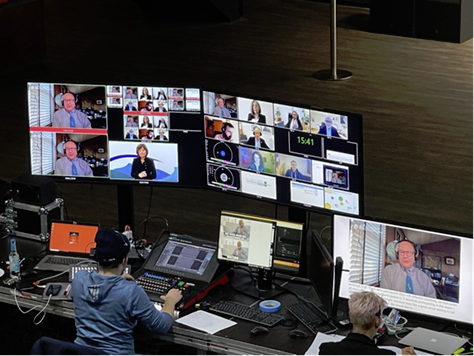
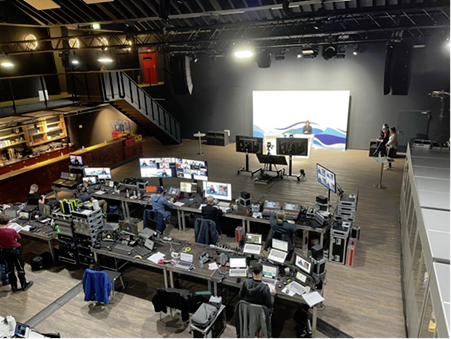
Photos below show the Berlin production studio for the webinar.
Manifesto for Clean Ocean
Jesse Ausubel served as lead author for the Manifesto of the Clean Ocean International Expert Group of the UN Decade for Ocean Science for Sustainable Development which presents its short list of activities and goals, and a strategy to reach them, at the three-day online conference on achieving a clean ocean 17-19 November. A Press Release is here.
Coverage highlights:
Agencia EFE, via Infobae, Argentina Expertos piden reducir hasta un 90 % los desechos marinos antes de 2030 https://www.infobae.com/america/agencias/2021/11/17/expertos-piden-reducir-hasta-un-90-los-desechos-marinos-antes-de-2030/
Newsbreak, United States A Clean Ocean by 2030: UN Experts’ “Clean Ocean Manifesto” https://www.newsbreak.com/news/2436864685283/a-clean-ocean-by-2030-un-experts-clean-ocean-manifesto
SciTech Daily A Clean Ocean by 2030: UN Experts’ “Clean Ocean Manifesto” https://scitechdaily.com/a-clean-ocean-by-2030-un-experts-clean-ocean-manifesto/
Podcast, Germany #4: Die Zukunft der Meere – mit Angelika Brandt https://www.podcast.de/episode/587607889/4-die-zukunft-der-meere-mit-angelika-brandt
Earth.com, United States Steps needed to achieve a clean ocean by 2030 https://www.earth.com/news/steps-needed-to-achieve-a-clean-ocean-by-2030/
Envirotec A clean ocean by 2030: UN panel charts “the most direct course”
Reducing marine debris by 2030: UN panel Indo Asian News Service, India (via ProKerala.com, potential reach 11,332,681, and 22 other news sites)
Achieving Clean Oceans by 2030: The “Clean Ocean Declaration” of UN Experts
(CN Beta), Mainland China (2,587,026)
Mark and Jesse give NOAA ‘Omics seminar on “Fishing for DNA”
Thanks to Tracy Gill and Katharine Egan, Mark Stoeckle and Jesse Ausubel gave a NOAA-wide “Omics” seminar. 29 October 2021. Title and abstract are below. View the recording of the webinar via Adobe Connect, here: https://noaabroadcast.adobeconnect.com/pnnos0mcsh3z/ Thanks to the attendees for lotss of great questions and the lively to-and-fro in the Chat Box.
Title: Fishing for DNA: how much water to catch and other questions
Abstract: Measuring quantities of eDNA is fast becoming a preferred method of learning the presence and abundance of fish and other aquatic species. But how much water need one filter and how much DNA need one process to obtain a reasonably complete and reproducible answer? Tests of an eDNA metabarcoding protocol for marine bony fish show more water, more species of fish up to levels tested. Amplifying decreasing amounts of extracted DNA yields progressively fewer species. Species represented by more copies (reads) of their DNA are detected more reproducibly and with less variation than lower-read species. Findings are consistent with Poisson distribution of rarer eDNA. We also vary PCR cycles, sequencing depth, primer concentrations, and primers. Our findings have multiple practical implications, including for survey strategies for both common and rare species, and identify some limits of knowledge and research directions for aquatic eDNA science.
Mark Stoeckle looks at a glass of water
PHE’s Mark Stoeckle shared our work on marine eDNA at Parsons School of Design, New School University on October 22, 2021. The online series invites artists and scientists to share perspectives on what they see when they look at a glass of water.
Article about Jesse’s orchard
The Martha’s Vineyard Times runs a bright article about The Cherry Orchard in Jesse Ausubel’s Backyard with 8 photos as well as an excellent text by Laura Roosevelt.
Podcast with Jesse Ausubel
Jesse reflects on decarbonization, dematerialization, land-sparing, industrial ecology, industrialization of the oceans, biological traces of fishes and of Leonardo Da Vinci, and the Seven Deadly Sins in an 83″ podcast with Robert Bryce, author of Smaller Faster Lighter Denser Cheaper: and A Question of Power: Electricity and the Wealth of Nations.
The Podcast is also on YouTube where you get to see who sings Take Me Out to the Ballgame.
DNA & Art Law essay published
A slightly revised version of Jesse’s April 2021 talk to the Art Law Committee of the New York Bar Association on Some DNA Issues for Art Law appears in the August issue of the Media Law Letter. The essay was stimulated by the Leonardo Da Vinci DNA Project.
eDNA book chapter by Alan Curry and Jesse Ausubel
We post the book chapter by Alan Curry and Jesse H. Ausubel, Biological information for the new blue economy and the emerging role of eDNA, in the comprehensive new book by Liesl Hotaling and Richard W. Spinrad (eds), Preparing a Workforce for the New Blue Economy: People, Products, and Policies Elsevier, 2021. Rick is now the Administrator of the National Oceanic and Atmospheric Administration.
A short version of the chapter appeared on 1 March in the magazine Maritime Executive as Biological information for the new blue economy and the emerging role of eDNA.
PHE Analysis of Moore’s Law published
PHE affiliate David Burg and Jesse Ausubel co-authored a paper published in PLOS ONE, Moore’s Law revisited through Intel chip density. Summarized here, the paper uses our LogletLab software to analyze the evolution of transistor density in state-of-the-art computer chips and how it corresponds to the famous ‘Moore’s Law.’
Coverage occurred in Chinese (TenCent News) and in German.
An earlier paper by Jesse and Nadja Victor used loglets to analyze DRAMs. This work fits with our generic interest in diffusion of technical and social phenomena.