Our beloved geographer colleague and friend Robert Kates passed away 21 April 2018 at the age of 89. Jesse met Bob in 1978 during preparations for the first UN World Climate Conference and they work closely together on studies of the impacts of climate variability and change for the next 20 years. Together they conceived and led the climate project of the Scientific Committee on Problems of the Environment (SCOPE) during the early 1980s, much of which was reported in RW Kates, JH Ausubel, M Berberian (eds), Climate Impact Assessment, SCOPE 27, Chichester: Wiley, 625pp., 1985. Bob also contributed an excellent chapter to Daedalus 125(3), 1996, The Liberation of the Environment, “Population, Technology, and the Human Environment: A Thread through Time,” pp. 43-72, edited by Jesse.
We post ‘The Potato and the Prius,’ the January 2018 keynote address by Jesse Ausubel to the Potato Business Summit of the United Potato Growers of America.
The Task Force on Ocean Biological Observations of the Partnership for Observation of the Global Oceans (POGO) has completed its Report. Jesse Ausubel served on the Task Force, whose report explores new genomic, acoustic, and optical approaches, and their synergies, especially in relation to the deep ocean, and some organizational strategies to speed progress.
“The oceanographic community is beginning to develop sensors, instruments, platforms and systems that will eventually make large scale and long-term ocean biological observation possible. There are developments in imaging, acoustic measurement and genomic sensing that show great promise for the future. Each development is in a different stage of maturity and there is great enthusiasm within the communities for investment in these capabilities. But we see no organization that is consistently fostering these capabilities. We believe that POGO has the long-term perspective, the ocean observation focus, the international scope, and the organizational convening power to take on a focus on ocean biological observation..”
Comments on the paper are most welcome.The study is grounded in and strongly supports Darwinian evolution, including the understanding all life has evolved from a common biological origin over several billion years.
The study follows mainstream views of human evolution. We do not propose there was a single “Adam” or “Eve”. We do not propose any catastrophic events.
Featuring: Jesse Ausubel, Karina Åberg, and Thomas P. Sakmar
Monday, February 12, 2018 6:00–7:15 p.m.Caspary Auditorium The Rockefeller University 1230 York Avenue at East 66th Street New York, NY 10065
DNA sequencing has revolutionized the study of human genetic variation, and insights derived from DNA now matter in diverse settings – from hospitals to courtrooms. Scientists are now also exploring information that DNA might yield about cultural heritage. For example, what can it reveal about works of art and their creators?
Leonardo da Vinci is widely recognized as one of the most extraordinary figures in human history. Leading up to the 500th anniversary of his death in 2019, an international team –– including anthropologists, artists, art historians, forensic experts, genealogists, microbiologists, physicians, and population geneticists –– has assembled to uncover new facts and insights about Leonardo. One of the ambitious goals of the team is to use pioneering methods to obtain traces of DNA attributable to Leonardo from artworks, notebooks or other sources.
On Monday, February 12, three members of The Leonardo DNA Project team – Jesse Ausubel, Karina Åberg, and Thomas P. Sakmar – will describe the origins of this remarkable project, provide a progress report on their research, and reflect on how this scientific inquiry may contribute to art history and conservation, while uncovering new information about Leonardo’s life, ancestry and exceptional abilities.
Jesse Ausubel, Director of the Program for the Human Environment at The Rockefeller University, has helped design and conduct major international research programs, including the Census of Marine Life, Barcode of Life initiative, and Encyclopedia of Life. His lab is now using very short sequences of loose DNA found in seawater to assess the status of marine life. He initiated The Leonardo DNA Project in 2014.
Karina Åberg is a visual artist with a longstanding special interest in the application of digital technology to education. Her unique skill set and enthusiasm about digital media and technology have facilitated her innovative contributions to digital design, advertising, communications and teaching. Her early training in Renaissance art techniques has led to several advances as a member of The Leonardo DNA Project since 2015.
Thomas P. Sakmar is a physician-scientist and the Richard M. & Isabel P. Furlaud Professor at The Rockefeller University, where he heads the Laboratory of Chemical Biology and Signal Transduction. His research program is dedicated to chemical biology and drug discovery research. His interest in visual sensory perception and the origins of creativity in science and the arts have led to his involvement in The Leonardo DNA Project since 2014.
Mark Stoeckle, together with co-authors Lyubov Soboleva (Hunter College) and Zachary Charlop-Powers (Rockefeller University), update their 2017 paper “Aquatic environmental DNA detects seasonal fish abundance and habitat preference in an urban estuary” (PLOS ONE e0175186). They extended their original six-month study to twelve months, making this one of the longest time series of fish monitoring by eDNA to date. The new analysis shows how little bits of DNA shed by fish track the seasonal movements of fish populations in and out of New York Harbor. eDNA also gives a picture of how the relative abundance of species differs from one habitat to another. These results help open our eyes to how eDNA can improve monitoring of ocean life.
This figure shows how many species were detected (black) and water temperature (blue) over the course of the year. Other figures and spreadsheets are posted and on FigShare
Jesse Ausubel will present the keynote address to the 2018 Potato Business Summit of the United Potato Growers of America at Potato Expo, 8am Wednesday 10 January. The slides and video are linked at www.potatobusinesssummit.com
Jesse Ausubel will give a free seminar open to the public Wednesday 6 December 2017 in Washington DC at the Smithsonian’s National Museum of Natural History on landless agriculture and rebounding nature.
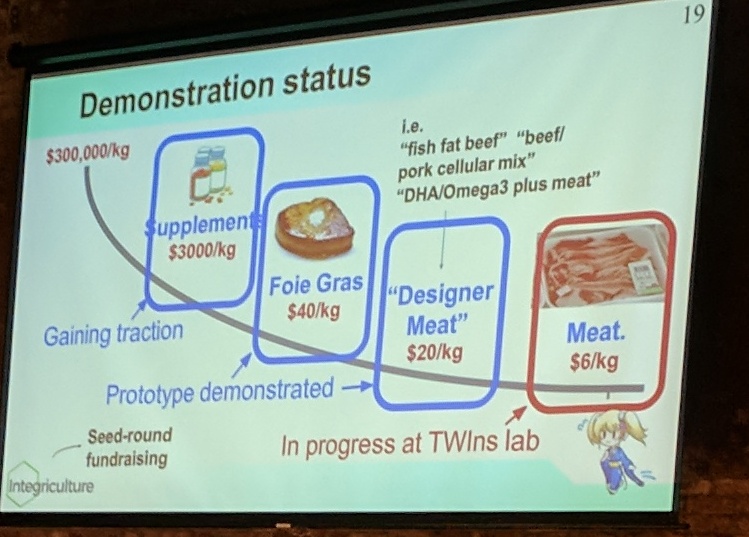
Alan visited the second annual New Harvest conference on cellular agriculture in Red Hook, Brooklyn, which included a variety of talks and exhibits on the science and broader implications of manufacturing food in vitro (from cell culture), as opposed to in vivo (from plants and animals). Technological advances have been achieved in growth media, more “lifelike” tissue engineering, and novel bioreactors designed to “brew” meat. Remaining challenges include the ability to successfully match the taste, texture, and cost of conventionally-sourced meat- and plant-based foods, as well as successfully scaling-up production processes. R&D is spread among a variety of corporate startups (e.g., Memphis Meats, Finless Foods), traditional academic labs (e.g., Tufts, NC State), and citizen science efforts (Shojinmeat Project).