In this 54″ video made 13 October, 2022 Jesse Ausubel, awarded the 2022 Nierenberg Prize for Science in the Public Interest, discusses whether the human species can continue to improve—much like cars, computers, or other technology—or whether our species has reached its peak.
Talks and Podcasts
Items related to talks Jesse Ausubel has given or will be giving in the near future.
Another podcast with Jesse about peak human and peak humans
Jesse H. Ausubel joins Jason Spiess on The Crude Life to discuss “Peak Human” and “Peak Humans” in a 34-minute podcast and explore new research showing how humans’ minds and bodies may near their limits and even start on a downward curve. “For 200-250 years humanity has had an incredible run,” Ausubel said. “When you think of your great grandparents, grandparents, parents and you, generally speaking you are going to be better… than they were.”
Jesse podcasts on “Peak Human?”
Journalist/author Robert Bryce interviews Jesse Ausubel about PHE’s work on “peak human” and “peak humans.” The interview covers four dimensions of human performance: the physical (how far and fast can we go?), lifetime (how long can we live and how well?), cognitive (measures of intelligence and learning), and immunity (is our resistance to disease waning?). The podcast was recorded on December 7, 2022. For the audio and transcript, see the Bryce website, and also on YouTube.
Fishing for DNA in the Hudson
In the morning of 3 November 2022, Jesse Ausubel summarized the work led by Mark Stoeckle about catching eDNA in the waters of New York City to learn about our local fish species. The site was the beautiful new Little Island in the Hudson River Estuary Park. We post the deck of slides which span from Central Park to the Hudson and East rivers to the Gowanus Canal and Coney Island. New York City enjoys the presence of dozens of fish species, ranging from eels to sturgeon.
2nd National eDNA workshop videos, slides
The proceedings from the 2nd National Workshop on Marine Enviromental eDNA 11-14 Sept 2022 in southern California have now been posted. Mark Stoeckle presented the opening Plenary.
- Agenda
- eDNA primer
- Training Day: Recording and Slides
- Plenary Day: Recording (Part I and Part II) and Slides (Part 1 begins with Mark Stoeckle’s talk)
- Virtual posters
Growing Cherries
The 18-page booklet “Growing Cherries and Thoughts About Other Fruits” relays Jesse Ausubel’s talk given at the Martha’s Vineyard Garden Club on 19 July 2022.
Andy Marshall Foundation seminar on experimentation, intellectual courage and mentorship
For its 2021 Annual Review, the Andrew W. Marshall Foundation presented an hour-long seminar in which Jesse Ausubel speaks briefly on experimentation, Melissa Flagg on intellectual courage, and Dan Patt on mentorship, followed by Q&A. IGood session. Jesse’s 5 minutes of remarks, titled Don’t Do Anything for the First Time, begin 15 minutes into the session following Jaymie Durnan’s opening review.
Video of Wrap-up of Clean Ocean webinar
For a global overview of marine pollution in 90 minutes, watch the lively Wrap-up session of the 17-19 November UN Ocean Decade “Clean Ocean” webinar Jesse co-moderated. Co-moderator begins the program and Jesse joins after about 4 minutes 30 seconds.
The Clean Ocean Manifesto and Press Release are here. The “Clean Ocean” initiative is one of the 7 components of the UN Decade of Ocean Science for Sustainable Development.
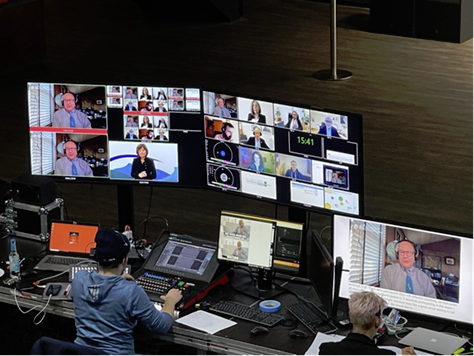
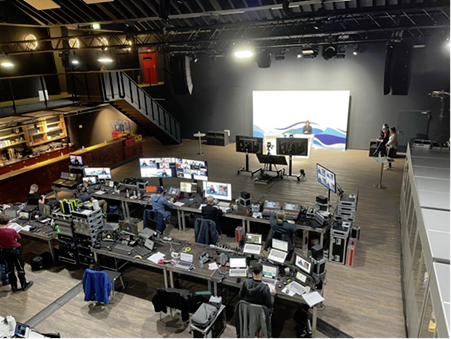
Photos below show the Berlin production studio for the webinar.
Mark and Jesse give NOAA ‘Omics seminar on “Fishing for DNA”
Thanks to Tracy Gill and Katharine Egan, Mark Stoeckle and Jesse Ausubel gave a NOAA-wide “Omics” seminar. 29 October 2021. Title and abstract are below. View the recording of the webinar via Adobe Connect, here: https://noaabroadcast.adobeconnect.com/pnnos0mcsh3z/ Thanks to the attendees for lotss of great questions and the lively to-and-fro in the Chat Box.
Title: Fishing for DNA: how much water to catch and other questions
Abstract: Measuring quantities of eDNA is fast becoming a preferred method of learning the presence and abundance of fish and other aquatic species. But how much water need one filter and how much DNA need one process to obtain a reasonably complete and reproducible answer? Tests of an eDNA metabarcoding protocol for marine bony fish show more water, more species of fish up to levels tested. Amplifying decreasing amounts of extracted DNA yields progressively fewer species. Species represented by more copies (reads) of their DNA are detected more reproducibly and with less variation than lower-read species. Findings are consistent with Poisson distribution of rarer eDNA. We also vary PCR cycles, sequencing depth, primer concentrations, and primers. Our findings have multiple practical implications, including for survey strategies for both common and rare species, and identify some limits of knowledge and research directions for aquatic eDNA science.
Podcast with Jesse Ausubel
Jesse reflects on decarbonization, dematerialization, land-sparing, industrial ecology, industrialization of the oceans, biological traces of fishes and of Leonardo Da Vinci, and the Seven Deadly Sins in an 83″ podcast with Robert Bryce, author of Smaller Faster Lighter Denser Cheaper: and A Question of Power: Electricity and the Wealth of Nations.
The Podcast is also on YouTube where you get to see who sings Take Me Out to the Ballgame.