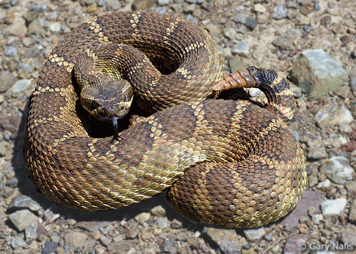
 If you hear this sound
  watch your step–a venomous rattlesnake may be nearby! Prompt administration of the correct antivenom can be life-saving.
The essential first step in toxinological research is reproducible analyses of venom toxins. However, in December 2005 Toxicon 46: 711-715 Pook and McEwing, University of Wales, report that reproducibility of toxin analyses is commonly compromised by “misidentification of species due to insufficient or changing knowledge of current snake systematics.”
Their article describes a breakthrough in toxinological research: DNA barcoding of dried venoms to provide an accurate, permanent “label” that is independent of future taxonomic changes. This short article is a powerful demonstration of how a standardized approach to identifying species by DNA that uses a public database linked to vouchered specimens, i.e. DNA barcoding, can benefit science and society. While some taxonomists will continue to wring their hands, others may be excited by this work, as it demonstrates how DNA barcoding ADDED TO (and not replacing) standard systematic practice can improve the accessibility and usefulness of ongoing taxonomic work for the larger biological community. I believe this article is enormously important, and I quote here at length.
From the Introduction: “Erroneous or uncertain taxonomy confuses the interpretation of results with respect to intraspecific and interspecific variation. Genuine logistical problems are encountered by non-specialists in taxonomy and snake systematics, in being able to keep up with taxonomic changes. The main hindrances include unresolved taxonomy for some species groups, and new data that change the definition of taxonomic units in others, with the result that the use of systematic information in the toxinological and clinical literature is disorganised. The problem is compounded further by changes in the concept of a particular species, and hence the interpretability of the venom used. Taxonomic confusion, however, has serious implications in snake venom research. The development of effective antivenom treatments and treatment strategies for envenomized patients necessitates a sound taxonomic framework. Accurate clarification of the identity of a given venom is paramount, even after taxonomic revisions involving the species concerned.”
Pook and McEwing “propose a solution to the long-term problem of species identification in toxinological work, utilising mitochondrial haplotypes isolated directly from snake venoms to provide a means of identification that will remain useful even in the face of radical changes in our understanding of the species concerned.”
From the conclusion: “The barcode strategy is dependent on the availablity of known mtDNA haplotype standards against which the sequences being investigated can be compared. Mitochondrial haplotype standards should be gene sequences from snakes of confirmed identity, which have been accessioned to a museum collection as voucher specimens.”









 A year ago in Science,
 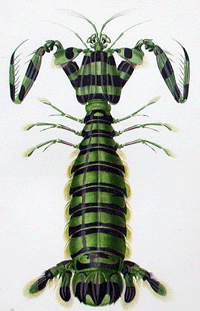 a what is thought to be a well-understood group, stomatopods, commonly known as mantis shrimp. Stomatopods are marine crustaceans distinct from true shrimp and are thought to include about 400 species worldwide. Like many marine species, they have a bipartite life cycle where dispersal is achieved through a planktonic larval developmental stage. However, larval stages are notoriously difficult to identify morphologically. Barber and Boyce first established a database of COI DNA barcodes from adult forms of nearly all known species. They then applied DNA barcoding to planktonic larvae collected in light traps at locations in the Pacific Ocean and Red Sea. Comparison of
 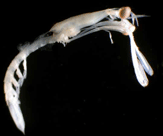 sequences from 189 larval forms revealed 22 distinct larval operational taxonomic units (OTUs), but a minority of these matched known species, suggesting that stomatopod species diversity is underestimated by a minimum of 50% to more than 150%. Their results support general use of DNA barcoding as a rapid, relatively-inexpensive first step in cataloging marine species with planktonic larvae. A similar approach has been applied on land by Smith et al “
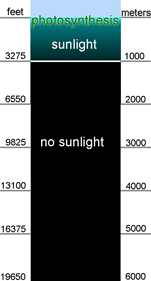 The deep oceans are the largest biotic space on earth, but remain largely unexplored.
 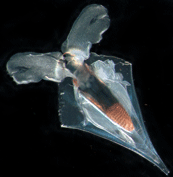 According to Ann Bucklin, lead scientist for CMarZ and Head of the University of Connecticut Marine Sciences Department, “we are just starting to realize how little we know about species variety. We used to think we knew many species well, but the advent of DNA barcoding has radically altered that perception. Genetically distinctive species of zooplankton are being found with increasing frequency.”