In 1997 Jesse, Fred Grassle, Mark Costello, and others conceived the Ocean Biogeographical Information System (OBIS) as the “what/where/when” database for the incipient Census of Marine Life. OBIS officially began in May 2000 and now celebrates its 25th birthday with recollections and meditations on the present and future. Its name is now the Ocean Biodiversity Information System.
News
Times of London on Leonardo DNA Project
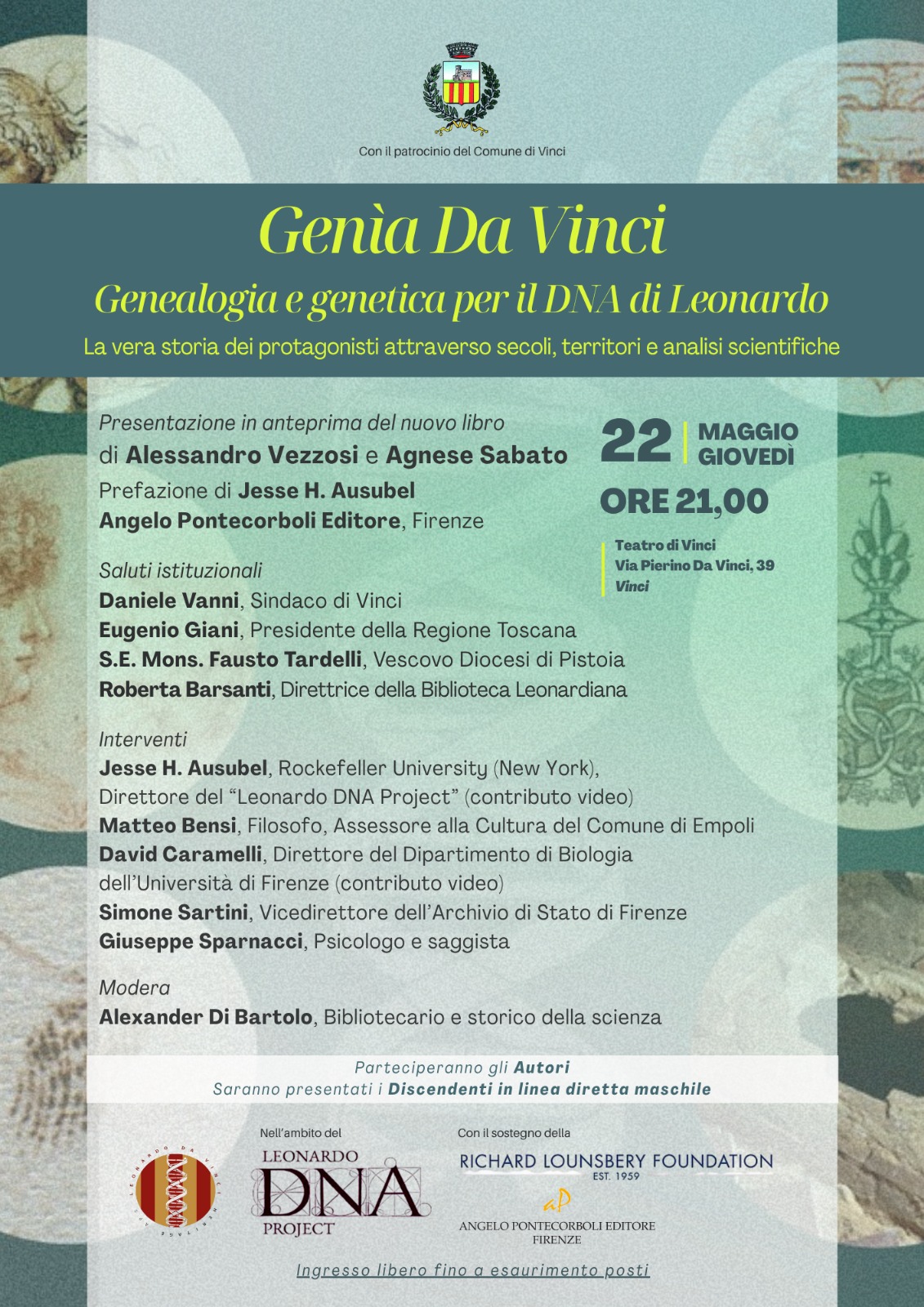
The new book on the Genealogy and Genetics of Leonardo Da Vinci by Alessandro Vezzosi and Agnese Sabato causes a blaze of interest in the Leonardo Da Vinci DNA Project (which Jesse co-founded and chairs) including this article in the Times of London. Congratulations to the authors, and the entire network, including Terry Collins. Jesse sent a statement but could not attend in person the public event in Florence. Thanks to Vinci mayor Daniele Vanni and Tuscany governor Eugenio Giani.
New in Loglet Lab 5.1
Thanks to Albert Strusberg, David Burg, Perrin Meyer, and Jason Walker-Yung we enjoy Loglet Lab 5.1.
What’s new:
Advanced the user interface:
Added graphing option form processing in the back-end.
Added scaling and normalizing function to process the data accordingly in the back-end.
Added the forecast for each line in the composite and components plot.
Completed corresponding Javascript (JS) coding to process the new data in the front-end graphs.
Adapted current database structure to save new parameters to library entries.
Adapted export/import logic to take into consideration all new parameters from the advanced UI.
Updated production database in the AWS server to the new database model.
Implemented the Logistic Substitution (LogSub) algorithm:
Created a multi-step algorithm in several modules to handle Logsub dataset creation based on the current input spreadsheet style form.
Adjusted the front-end logic to process the Logsub plotly JS data accordingly when using the Logsub model.
Adjusted the library logic to handle loading and saving Logsub data.
Adjusted the import/export logic to also save Logsub data when required.
Created new type of graph using Plotly JS for stack/market share data.
New features and miscellaneous bug fixes:
Added statistics to the advanced UI table. Statistics now include several parameters: RMS, MAD, MAPE and AIC.
Fixed bug when saving certain kind of datasets to the library.
Fixed X ranges calculation for the composite graph.
Fixed several import/export bugs for certain kind of datasets.
Fixed logic to handle certain kind of datasets when some of the rows contains NAN or zeros values.
Fixed the guessing initial parameters logic for the Logsub model.
All datasets transferred to from LL4 to LL5’s library
Documentation
Fixes and typos corrected
Additions according to the changes for v5.1
AWS:
LL4 has been removsed from AWS. Code is still available on Github.
LL5 – live long and prosper!
Quiet Ocean program’s 14th newsletter
The International Quiet Ocean Experiment has published its 14th newsletter, reporting on remarkable progress on the Global Library of Underwater Biological Sounds and other matters. The genesis of the IQOE was in Jesse’s essay, Broadening the scope of global change to include illumination and noise.
Human Progress newsletter on Iddo’s evidence of dematerialization
Marian Tupy publishes America’s Commodity Appetite: Evidence of Dematerialization: America’s economy has grown better at extracting more value from less stuff, an accurate article about Iddo’s recent paper.
DNA of New York City’s East River
Mark Y. Stoeckle and Jesse H. Ausubel
Animals shed environmental DNA (eDNA) into the environment. Sources include cells sloughed from body surfaces, body wastes, and tissue remnants following predation, death, or injury. eDNA is a bit like dandruff. DNA of course consists of long strands of four chemical compounds: cytosine (C), adenine (A), guanine (G), and thymine (T). Researchers use strands of about 100 “letters” from variable parts of the genome, like a long telephone number, to identify the species of animal from which the DNA comes. Acidity, heat, and light can speed eDNA degradation, and bacteria eat eDNA. A rule of thumb is that eDNA sufficient for reliable identification lasts about 24 hours and thus gives a good current portrait of life in a water body.
As seen in these 5 slides, the PHE’s Mark Stoeckle regularly collects a half liter of water from the East River adjacent to the Rockefeller campus (slide 1) with a bucket on a string, filters the water, extracts the DNA from the sediment on the filter using special chemicals called primers to grab only the DNA that came from vertebrates, sequences these pieces of eDNA, and matches the sequences against genetic libraries. The number of copies for each species corresponds well to the recent abundance of that animal in the East River.
Our vertebrate eDNA studies show that that the East River abounds in fishes (slide 2), with tautog most common but also herring, bass, and eel. The presence of water from sewage treatment plants and rains that wash city streets also brings DNA of urban wildlife into the East River. A cup of water from the East River reports the abundance of rats, pigeons, dogs, and cats (slide 3). It also reports the presence in the River or nearby of additional wildlife ranging from deer and beaver to seal and dolphin (slide 4). Finally, the eDNA in the East River neatly tracks the diet of humans of New York (slide 5). The fractions of aquatic eDNA of commonly consumed meats such as chicken and cow match nicely with national data on meat consumption. An exception is sea bass (branzino), widely served in New York City restaurants and thus common in East River water samples but a tiny proportion of the national fish diet.
eDNA revolutionizes the ability for people to know, affordably, what animals live in or use the waters near them. eDNA will be a routine component of fish stock assessment, detection of invasive species, and monitoring effects of coastal storms and climate change. Genomics enables a cup of water to tell the natural history of the East River.
Iddo pens summary of American dematerialization
In his Honest Broker blog, Roger Pielke, Jr., kindly gives space for Iddo Wernick’s essay “Counting Materials: How the use of 100 materials has changed in the United States since 1970.“
Very small nuclear power applications
In November 2013 Jesse Ausubel chaired a working group in an National Academy of Sciences Keck meeting on New & Practical Applications of Nuclear Technologies. We post the 10-slide report from the Working Group, which appears timely in 2025.
Coverage of Iddo’s USA Dematerialization paper
MSN.com covers The material revolution: How USA’s commodity appetite evolved from 1900 to present as does RealClear Science in Since 1970, Demand for These Eight Materials Has Grown Fastest.
PHE’s work on Dematerialization
Iddo Wernick’s new paper “Is America dematerializing? Trends and tradeoffs in historic demand for one hundred commodities in the United States,” published in the Elsevier journal Resources Policy, available at https://bit.ly/4ahubvh, evokes the more than three decades of work on materials flows by members of our group, including:
JH Ausubel. The Environmental Trinity – Decarbonization, Dematerialization, Land-Sparing, also posted at The Honest Broker, 20 June 2024.
JH Ausubel. Nature Rebounds. The Breakthrough Journal 5, 2015 This article was originally delivered as a Long Now Foundation Seminar, San Francisco, 13 January 2015 and appeared under the title “The Return of Nature: How Technology Liberates the Environment” in the Journal of the Breakthrough Institute Spring 2015.
JH Ausubel, IK Wernick. The Shrinking Footprint of American Meat. The Breakthrough Journal 2017.
JH Ausubel, PE Waggoner. Dematerialization: variety, caution, and persistence. Proc Natl Acad Sci U S A 105 (35): 12774–12779, 2008 10.1073/pnas.0806099105 D.
JH Ausubel, S Rao. Is Richer Greener?, 2 December 2008 presentation.
IK Wernick, R Herman, S Govind, JH Ausubel. Materialization and Dematerialization: Measures and Trends. Pp. 135-156 in Technological Trajectories and the Human Environment, JH Ausubel and HD Langford, (eds.). National Academy Press, Washington, DC, 1997
IK Wernick. Consuming materials: the American way. Pp. 111–122 in Technological Forecasting and Social Change vol. 53, 1996.
IK Wernick, JH Ausubel. National Materials Flows and the Environment. Pp. 463–492 in Annual Review of Energy and the Environment vol. 20, 1995 Republished in Measures of Environmental Performance and Ecosystem Condition, P. Schulze (ed.), National Academy, Washington, D.C., 1999, pp. 157-174.
IK Wernick. Dematerialization and secondary materials recovery in the U.S.. Journal of the Minerals, Metals, and Materials Society 46 (4): 39–42, 1994.
R Herman, SA Ardekani, JH Ausubel. Dematerialization. Pp 50-69 in J.H. Ausubel and H.E. Sladovich, eds., Technology and Environment, National Academy, Washington DC 1989. Also in Technological Forecasting and Social Change 37(4):333-348, 1990.