Jesse’s niece, Ramona Ausubel, has published a novel, The Last Animal, about a woolly mammoth starting a modern life. A companion essay, Science and Fiction Are Experiments That Ask the Same Question, interleaves some exchanges involving Ramona and Jesse.
Blog
Another prize for eDNA work for high school star Samara Davis
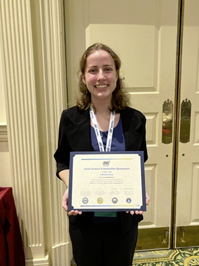
A high school student Mark Stoeckle has mentored, Samara Davis (Ossining High School, Westchester), earned one of the very top prizes in the national Junior Science and Humanities Symposium sponsored by top levels of the Department of Defense. Samara’s project used eDNA to learn about the presence of animals (rare salamanders in particular) from vernal pools (temporary pools of water). Very neat DNA forensics! Congratulations to Mark and to Samara, who will start Yale College in September.
Here’s the tweet from the competition: They will post the winners on this website later. Here is Samara enjoying the moment:
Passing of Cesare Marchetti
Cesare Marchetti passed away this morning in Tuscany just short of his 96th birthday. After meeting Cesare in 1978, Jesse Ausubel became fascinated with Cesare’s ideas about the importance and ubiquity of processes of growth and diffusion captured often in simple form by Lotka-Volterra equations and subsequently coded in our Loglet Lab software. In the early 1980s Jesse began assisting Cesare on some projects and subsequently worked together on subjects ranging from electricity to travel to human populations and empires (see below). And of course Leonardo Da Vinci.
Cesare is best known for Marchetti’s Constant that posits that the human time budget for travel is a little above one hour per day, since ever and everywhere, because anthropologically rooted in the dangers homo sapiens faces when outside a protected environment.
Cesare was one of the inventors of geoengineering. His most cited paper is On geoengineering and the CO2 problem (1977).
Around 1970 he was also one of the inventors of the hydrogen economy as described in this 1973 paper: Hydrogen and energy.
A bibliography with links to many of Cesare’s papers from 1952 to 2007 is here. A second list of publications is here.
Cesare’s explorations of Leonardo are here.
Our group at The Rockefeller University always greatly enjoyed hosting Cesare in New York City, and he reciprocated with marvelous hospitality in Monteloro.
Our joint efforts included:
C Marchetti, JH Ausubel. Quantitative Dynamics of Human Empires [Color Booklet Version, 52 pages]. Adapted from Marchetti and Ausubel, International Journal of Anthropology 27(1-2):1-62, 2012. 2013
JH Ausubel, C Marchetti. Science, Conquering Child of the Church . 2003 Draft prepared for Next 1000 Years meeting, 9-10 October 2003
C Marchetti, JH Ausubel. The Next 1000 Years. 2003 Discussion paper for April 2003 Rockefeller U workshop
JH Ausubel, C Marchetti. The Evolution of Transport. The Industrial Physicist 7 (2): 20–24, 2001
JH Ausubel, C Marchetti, PS Meyer. Toward Green Mobility: The Evolution of Transport European Review 6 (2): 143–162, 1998
JH Ausubel, C Marchetti. Elektron: Electrical Systems in Retrospect and Prospect Pp. 110–134 in Technological Trajectories and the Human Environment, J.H. Ausubel and H.D. Langford, (eds.). Washington, DC: National Academy Press, 1997 Also appeared in Daedalus 125(3):139-169, Summer 1996.
C Marchetti, PS Meyer, JH Ausubel. Human Population Dynamics Revisited with the Logistic Model: How Much Can Be Modeled and Predicted? Pp. 1–30 in Technological Forecasting and Social Change vol. 53, 1996.
Requiescat in pace.
Ausubel-Gaffney on Op-Ed on Defense Basic Research
RealClear Defense publishes “Let’s Stop Low-Balling Defense Basic Research,” a short opinion piece by Jesse Ausubel and Paul Gaffney.
Mark & Jesse present NOAA ‘Omics seminar on eDNA abundance
Mark Stoeckle and Jesse Ausubel presented in the NOAA ‘Omics Seminar Series on Marine fish eDNA Metabarcoding: Promising Developments and Early Applications. The outline:
–eDNA abundance matters (relevant to detection, quantification, field design, laboratory protocols)
–Adding internal standard to metabarcoding PCRs quantifies eDNA (converts relative sequence reads to absolute eDNA copies)
–Current marine fish metabarcoding protocols ready for wider use (reasonably accurate index of fish abundance, especially for more abundant species)
–eDNA metabarcoding can overcome information hurdles for ecosystem-based management
A recording is here , 40-minute presentation and 20-minute Q&A. Thanks to NOAA’s Katharine Egan and Nicole Miller.
Leonardo in American Academy Bulletin
The Winter 2023 issue of the Bulletin of the American Academy of Arts & Sciences publishes “The Search for Leonardo’s Genome” by Jesse Ausubel. Based on Jesse’s June 2022 talk, this version omits the citations included in Jesse H. Ausubel, The Search for Leonardo’s Genome, Human Evolution 37 (3-4): 221-228, 2022.
Mark’s talk at the 6th Annual Environmental DNA Technical Exchange Workshop (6eDTEW)
On January 24, 2023, Mark Stoeckle presented our recent work on measuring marine fish eDNA abundance at the sixth annual Environmental DNA Technical Exchange Workshop (6eDTEW), sponsored by interagency US Government eDNA Working Group.
Loglet Lab 5 beta available for use
LogletLab 5, now in beta version, offers new web-based features for single and multiple logistics. We welcome feedback. We plan in the spring to release 5.1 with more fitting algorithms and also logistic substitution.
Video of Jesse’s Nierenberg Prize lecture on “Peak Human?”
In this 54″ video made 13 October, 2022 Jesse Ausubel, awarded the 2022 Nierenberg Prize for Science in the Public Interest, discusses whether the human species can continue to improve—much like cars, computers, or other technology—or whether our species has reached its peak.
Another podcast with Jesse about peak human and peak humans
Jesse H. Ausubel joins Jason Spiess on The Crude Life to discuss “Peak Human” and “Peak Humans” in a 34-minute podcast and explore new research showing how humans’ minds and bodies may near their limits and even start on a downward curve. “For 200-250 years humanity has had an incredible run,” Ausubel said. “When you think of your great grandparents, grandparents, parents and you, generally speaking you are going to be better… than they were.”