Jesse was interviewed by Daniel Sieberg of CBS News for an Eye to Eye segment on The Encylopedia of Life. You can watch the four minute video here.
News
100 million years without sex: COI clustering in bdelloid rotifers challenges theories of how species are formed and maintained
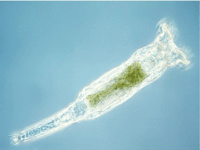 Why are there species? The usual answer is sex: reproductive isolation maintains differences between species and reproductive mixing maintains similarity within species. According to recent work with bdelloid (the “b” is silent) rotifers, a group of microscopic invertebrates thought to have adopted asexuality 100 million years ago, sex is not necessary! In September 2005 Hydrobiologia 546:29, researchers at the University of Arizona analyzed mitochondrial COI of 102 females of 21 morphologically defined species of bdelloid rotifers, including many sympatric morphospecies. Contrary to predictions of evolutionary theory for asexual organisms, Birky et al show that these are 21 independently evolving clades, with small differences within and large differences among lineages, the same patterning seen in COI analyses of sexual reproducing species. Also contrary to predictions, the Ka/Ks ratio (expressed/silent mutations) indicates that COI is subject to strong selection. [In asexual organisms, there is less need for sampling multiple genes because the entire genome is a single linkage unit. Thus genetic differences in COI are expected to reflect evolutionary history of the organism, i.e. the “gene tree” is expected to be the same as the “species tree.”] (For fun see Birky lab bdelloid video!)
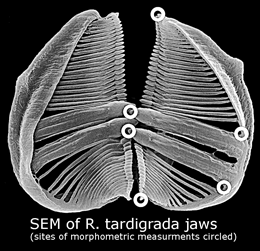 In April 2007 PloS Biology researchers from University of Milan, Italy, Imperial College London, University of Cambridge, and Royal Botanic Gardens, Kew analyze morphometric and molecular data of a comprehensive international sampling of Rotaria sp. bdelloid rotifers. All 9 morphologically defined taxonomic species form monophyletic clades in genetic analysis. Multiple clusters in several morphospecies show distinct morphometric measurements of mouth parts, suggesting these represent cryptic species with ecological specialization. Fontaneto et al observe “bdelloids display the same qualitative pattern of genetic and morphological clusters, indicative of diversification into independently evolving and distinct entities, as found in sexual clades” and conclude “this refutes the idea that sex is necessary for diversification into evolutionary species.”
In these studies, COI sequences accurately identify bdelloid rotifer species, further demonstrating the robustness of DNA barcoding. What is scientifically exciting is how broad application of standardized, minimalist genetic analysis (aka DNA barcoding), combined with traditional morphologic and ecologic study, is providing radical new insights into biology.
Fungal database a Tower of Babel, needs rebuilding
Early in Michael Crichton’s 1990 novel Jurassic Park, Dr. Henry Wu, chief scientist at Jurassic Park Research Insitute, showing visitors around his facility, displays “the actual structure of a small fragment of dinosaur DNA“. Astute readers pointed out Dr. Wu’s dinsosaur genetic resuscitation project was unlikely to succeed, as the sequence in Crichton’s novel was a fragment of the bacterial plasmid pBR322. They discovered this by feeding the “dinosaur sequence” into the online BLAST software engine, which searches the billions of base pairs of nucleotide sequences deposited in the amazing public resource of GenBank and the other international genetic databases, EMBL and DDBJ.
The power of genetic databases as identification tools rests on the quality of sequences and their annotations. Just as we need regularly updated maps for safe navigation, we need regularly updated genetic databases for accurate identifications.
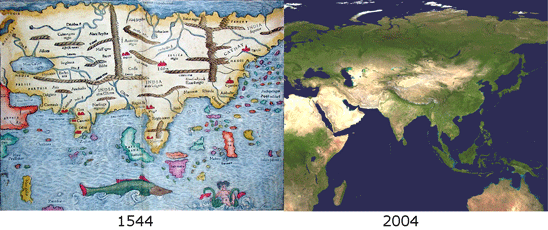
One of the strengths of GenBank is that it serves as a permanent repository for genetic sequence data. As a result, GenBank is sometimes a permanent repository for faulty data. In a recent PLoS One paper, researchers from Goteborg University and Chalmers University of Technology, Sweden, and University of Tartu, Estonia, examined the taxonomic reliability of the 51,534 fungal internal transcribed spacer (ITS) sequences in the International Nucleotide Sequence Database (ie GenBank, EMBL, DDBJ). ITS is the most widely used locus for species identification in fungi.  The results show a “variegated picture of the taxonomic status of publicly indexed fungal sequences“. Taxonomic coverage is sparse: of the estimated 1.5 million fungi, less than 1% (9,684 species) are represented. Taxonomic data is lacking for many sequences (27% are not identified to species level), and most of the species-level identifications are unverifiable (82% are not linked to voucher specimens, 63% are not tagged with specimen country of origin, and 42% are marked as unpublished). Sequence comparisions suggest mislabeling is common (11% show best matches to congeneric but heterospecific sequences, and another 7% match among species of a different genus. Overall 10-21% of the INSD sequences have incorrect or unsatisfactory annotations.
It seems better to start over than to try to revise this Tower of Babel. Nilsson et al conclude “the large body of insufficiently identified fungi in INSD constitutes a silent plea for a wide and generalized sequencing effort of well-identified and -annotated [type] specimens residing in herbaria worldwide.” Toward this end, an All-Fungi Barcoding Initiative Workshop will be held 14-15 May 2007 at the Smithsonian Center for Research and Conservation, Fort Royal, Virginia. An international collection of researchers aim to hammer out how to build a reliable database, including which gene(s) should be adopted as standard barcode targets.
So far, DNA-based fungal identifications have primarily used ITS. Other nuclear genes have been used in some studies including the nuclear large ribosomal subunit, beta-tubulin, and elongation factor 1-alpha. It would be excellent if the fungal barcode database could link directly with those being built around the mitchondrial gene COI, which is effective for resolving most protozoan and metazoan (multicellular animal) species examined so far. In this regard it is exciting that a report by Seifert et al in 6 March 2007 Proc Natl Acad Sci USA shows COI provides species-level resolution similar to that for ITS, amplification was generally straightforward, and introns in the COI gene were found in only 2 of 370 Penicillium strains.
Chauncey Starr
Chauncey Starr, who helped launch the Program for the Human Environment, passed away on 18 April 2007, shortly after his 95th birthday celebration. In fond memory of Chauncey, we post his biography, a list of key papers, and obituary. At Chauncey’s 90th birthday, Jesse offered a brief tribute.
Global Warming and the Industrial System
Our colleague Iddo Wernick‘s case study “Global Warming and the Industrial System” is published by the International Relations and Security Network, Zürich, Switzerland.
Resolving leaves and branches?
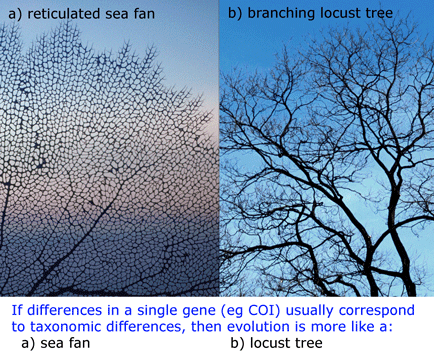
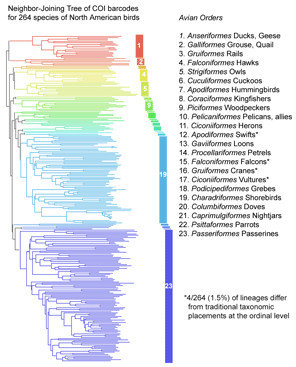 COI barcoding is a standardized approach to identifying species by DNA, helping resolve the “leaves” on the tree of life. Will the growing arrays of COI sequences also help provide insight into evolutionary history, the “branches” of the tree? I am struck that in some cases, simple genetic arithmetic with COI sequences creates trees very similar to modern phylogenies painstakingly created from multiple nuclear and mitochondrial genes, multiple morphologic characters, and exhaustive computerized analysis. Shown at right, a neighbor-joining analysis of COI barcodes of 264 species of North American birds creates a tree that is quite similar to the most recent understanding of relationships among modern birds, with anseriformes (ducks and geese) next to galliformes (grouse and quail) at the top, passeriformes (perching birds) at the bottom, and most of the other established orders appearing as single lineages in between. Most of the families and groupings of families within these orders also match current understanding, including for example, that flycatchers appear as the basal lineage within passeriformes, and a group of New World passerines called nine-primaried oscines appear together at the bottom of the tree. Of course, a systematist would immediately note that the statistical support for these higher-order branches is weak or absent. I should tread lightly here or not at all, since phylogenetics is the province of mathematical experts, but I will plunge ahead anyway and suggest that, if the single gene neighbor-joining distance tree is “right” say 8 times out of 10, then the apparent lack of statistical support for higher order branches is misleading. There are cases where the COI gene tree is incorrect (eg Hajibabaei et al Genome 49:851 2006).
I close with a picture inspired by the data. If single gene trees usually correspond to evolutionary history, this implies strong barriers to gene flow arise concurrent with differences in the single gene and are continuously maintained.
Australian energy talk
On 16 April Jesse delivers “The Future Environment for Energy Business” to the APPEA conference in Adelaide. Here are the figures.
Seeing in color
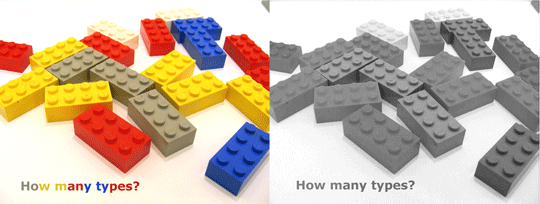
A raft of recent articles show the strength and versatility of a standardized genetic approach to identifying species, ie DNA barcoding. Just as color vision helps us rapidly sort objects into unambiguous categories, DNA analysis usually reveals distinct differences among species, including those whose biological differences lie outside the range of our perception, ie cryptic species. I highlight two of the recent articles below.
In March 20, 2007 Proc Natl Acad Sci USA, researchers at University of Guelph, Canadian Agricultural Department, and University of Pennsylvania apply DNA barcoding to 16 species of apparently generalist parasitoid tachnid flies. Smith et al found 73 distinct mitochondrial DNA lineages among 2,134 flies from the 16 morphospecies. The mitochondrial lineages were supported by collateral ecological differences and, where tested, by independent nuclear gene markers. In an accompanying commentary, Scott Miller, Smithsonian Institution, looks at how DNA barcoding is contributing to the “renaissance of taxonomy” and is “emerging as a cost-effective standard for rapid species identification”.
In 26 March 2007 Mol Ecol Notes, scientists from the University of Auckland apply DNA to identifying rat species in Southeast Asia. Geographic variation in mitochondrial DNA of commensal rats provides a window into patterns of human dispersal and migration, but studies are complicated by the presence of multiple rat species in Southeast Asia, and the difficulty of distinguishing among species in subfossil remains at archeological sites. Robins et al found DNA barcoding with COI mtDNA barcodes distinguished most species, even when short DNA fragments of COI were used (such as might be recoverable from sub-fossil material), and was similarly effective as tree-based methods using COI, cytochrome b, and D-loop sequences. The genetic methods revealed some polytypic and paraphyletic species, suggesting a need for taxonomic revisions in this group.
Industrial ecology in Bangladesh
The Daily Star newspaper, Dhaka, Bangladesh, runs an article about Industrial Ecology that mentions our ideas about foamed glass as a construction material that captured the imagination of Ivan Amato for Time magazine several years ago.
Finish for trains and start for maglevs?
The French “train a grand vitesse” (TGV) attained a record speed for a train on wheels of 568 km/hr on 31 March 2007. The history of technology shows that when a new technology like the steamship appears, the old one makes a final spurt to beat it. Recall the magnificent
|
The Industrial Physicist 7(2):20-24, April/May 2001. |
|
European Review 6(2):143-162, 1998. We envision a transport system producing zero emissions and sparing the surface landscape, while people on average range hundreds of kilometers daily. We believe this prospect of “green mobility” is consistent in general principles with historical evolution. We lay out these general principles, extracted from widespread observations of human behavior over long periods, and use them to explain past transport and to project the next 50 to 100 years. Our picture emphasizes the slow penetration of new technologies of transport adding speed in the course of substituting for the old ones in terms of time allocation. We discuss serially and in increasing detail railroads, cars, airplanes, and magnetically levitated trains (maglevs). |