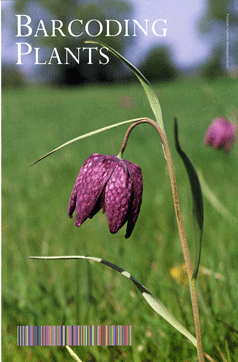
 Plant researchers from 11 world herbaria are investigating DNA regions for their potential as barcodes for land plant species. From the project rationale: “although the mitochondrial gene region, CO1 ( cox1 ), has already been used with considerable success across a range of animal groups and shows promise in at least some algal groups, it is characterized by relatively low rates of sequence divergence in land plants. Mitochondrial DNA in land plants also undergoes rearrangements, exhibits incorporation of foreign genes and frequent transfer of some genes to the nuclear genome. It is therefore desirable to find an alternative region or, if necessary, regions from one of the other genomes that would be suitable as a barcode.”
This project aims to establish a standard DNA barcode for land plants. Phase 1, completed in December 2005, was a survey of regions that have potential as land plant barcodes. Phase 2, to be completed by January 2007, is to “ground test” the most promising regions in a series of parallel case studies that incoporates representatives of all major land plant lineages.
If this competition is successful, it should be relatively straightforward (ie fast and inexpensive) to compile a comprehensive library of plant DNA barcodes, as there are only about 500,000 known plant species, the world catalog is thought to be essentially complete, and there are several herbaria with large specimen and DNA collections.
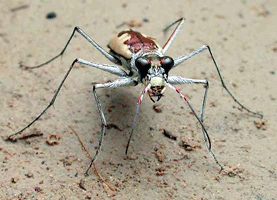
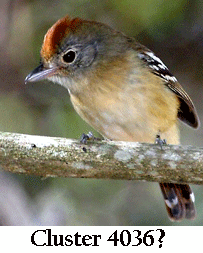
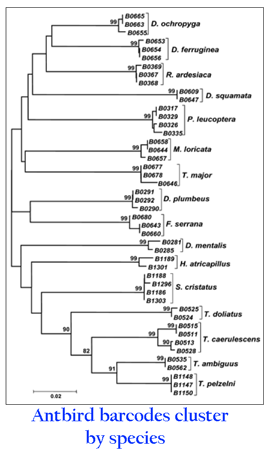
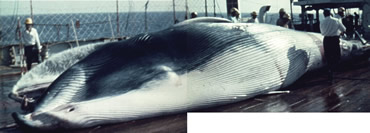 Do you see a new species anywhere? Baleen whale specimen collected in 1976, new species description 27 years later based in part on mitochondrial DNA characters (Wada et al. 2003. Nature 426:278)
 With funding from the Gordon and Betty Moore Foundation, researchers at Reveo, Inc. and the University of Washington are collaborating on developing a
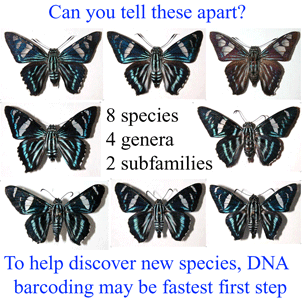 Brower’s article argues about how many Astraptes species are supported by the sequence data, worries about possible consequences of the rise of DNA barcoding, and misses the scientific opportunity to examine this very young species complex with a large set of morphologic, ecologic, and sequence data. He concedes “there are probably at least three species” but declines to put forth what criteria can be used to delimit species. I was surprised to read that the question of whether two sequences “belong to the ‘same species’ is a metaphysical one”.