Scanning mosquito barcodes to help solve disease mystery

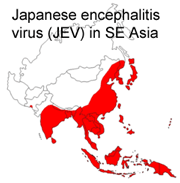
What limits Japanese encephalitis virus (JEV) to its current range? JEV is a mosquito-transmitted flavivirus related to yellow fever and West Nile viruses that causes approximately 40,000 human cases annually in SE Asia. Although regular epidemics occur in islands off Papua New Guinea as close as 70 km to Australia and the major JEV vector in Papua New Guinea (PNG), Culex annulirostris, is found throughout Australia, there have only been sporadic cases in Australia and the disease has not become established there.
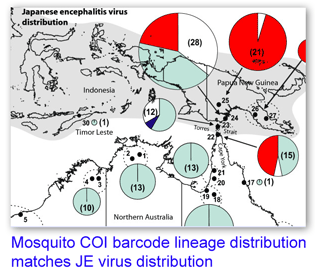
In 29 June 2007 BMC Evol Biol researchers analyzed mitochondrial COI and nuclear ITS 1 sequences in 273 mosquitos identified as Culex annulirostris or its close relatives Cx. palpalis and Cx. sitiens, collected at 30 locations in Australia and Papua New Guinea.  Hemmerter et al found that 10% of morphological identifications were incorrect, based on ITS 1 sequences, and there was “100% agreement between the ITS 1 diagnostic and the COI sequence grouping of Culex spp.” Bayesian phylogenetic trees with COI showed “distinct geographically-structured lineages” (ie possible cryptic species) within the vector species Culex annulirostris, and two of the four Cx. annulirostris lineages are restricted to PNG, with a southern limit at the top of Australia’s Cape York peninsula, “which correlates exactly with the current southern limit of JEV activity”.  Analysis of blood meals reveals the Australian Cx. annulirostris feed mainly on marsupials (PNG lineages feed on wild pigs which are the primary JEV reservoir), and laboratory studies indicate Australian Cx. annulirostris is an inefficient vector for JEV. As the authors note, it seems likely these genetically and biologically distinct lineages are likely different species.

One limitation of this study is that the COI region analyzed does not match the COI barcode region. By my analysis the 538-bp fragment analyzed in this study starts at position 359 in COI. As the defined COI barcode region is 648 bp starting at position 58, there is only 289 bp overlap between the sequences in this study and COI barcodes.  It appears generally straightforward to amplify COI barcodes from insects including mosquitos, so I hope the next study on genetic differences in human disease vectors will amplify the COI barcode region, as that will enable linking the results to the growing DNA barcode library, amplifying the power of the research itself. 

I conclude that routine application of standardized genetic testing, ie DNA barcoding, will help in understanding the distribution of mosquito biodiversity, with implications for human health.
Marine barcode of life initiative joins web panoply

In July 2007 the Marine Barcode of Life initiative (MarBOL) surfaced at www.marinebarcoding.org. MarBOL is “an international initiative to enhance our capacity to identify marine life by utilizing DNA barcoding”. It is an offspring of the Census of Marine Life (CoML), a ten-year initiative to assess and explain the diversity, distribution, and abundance of marine life in the oceans and the DNA barcode initiative.

The target list for MarBOL includes the diverse invertebrates that inhabit the oceans, as well as marine mammals, fish, and birds. MarBOL will be compiling barcodes collected through CoML projects, including those focused on marine zooplankton (CMarZ), pelagic animals (TOPP), nearshore environments (NaGISA), reefs (CReefs), continental shelves (COMARGE), seamounts (CenSeam), deep water vents (ChEss), abyssal plains (CeDAMar), Arctic Ocean (ArcOD), Antarctic Ocean (CAML), northern Mid-Atlantic ridge (MAR-ECO), Gulf of Maine (GoMA), northeastern Pacific continental shelf (POST), and perhaps even marine microbes (IcoMM)! The project will also utilize barcodes collected by ongoing barcoding initiatives on fish, birds, and sponges.

CoML Bluefin Tuna

The abundance of bluefin tuna in the North Atlantic are the subject of a Census of Marine Life press release . The original tuna papers as well as tuna images and video are are on the CoML Portal.

EOL Videos

The 8-9 May 2007 public launch of the Encyclopedia of Life included short appearances by Jesse on Reuters television and on the CBC evening news.

Part stands for the whole

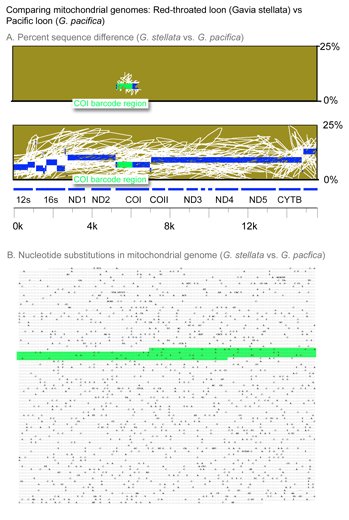
A synecdoche is a figure of speech in which a part stands for the whole, or the whole stands for a part. Taking the first, we might consider a DNA barcode as a synecdoche, in which the short barcode gene fragment stands for whole genome. As in the figure, a COI barcode usually encapsulates the differences found elsewhere in the mitochondrial genome. Because COI barcodes generally capture the discontinuities we recognize as species, we can surmise that differences in this short mitochondrial gene fragment usually reflect differences in the nuclear genome. More study of variation within and among species will help understand why differences in mitochondrial and nuclear genomes appear inextricably linked. 

for larger version click here

DNA barcode helps describe new goby, a vertebrate first

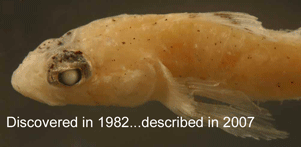
In 12 July 2007 Zootaxa, Benjamin Victor, Ocean Science Foundation and Nova Southeastern University, describes a new species of goby Coryphopterus kuna from the western Caribbean. Although species descriptions often cite DNA sequence differences as evidence for species status, the sequence data itself is usually not shown. Victor’s work is the first vertebrate species description that includes the holotype mtCOI DNA barcode, a simple step that will enable more persons to identify this fish regardless of life stage (egg, larva, and adult forms of an individual all have the same DNA of course) or whether specimen is in bits and pieces, as in stomach contents of a predator for example.  (For a look at the strange diversity of fish larva, see Victor’s web-based photographic guide to larval fishes of the Caribbean).

The process that leads to taxonomic recognition of new species is often glacially slow. In this case the holotype specimen was collected off the coast of Panama in 1982, twenty-five years ago. Just as the Human Genome Project generated enormous amounts of raw sequence data, genetic explorations of biodiversity, including DNA barcoding, are creating vast amounts of data that outpace the ability of traditional species descriptions to keep up. Making the sequence and specimen data available through public databases in BOLD and GenBank might lead others to find to new ways of analyzing biodiversity in addition to the stately process of formal species descriptions.

Earth at Night

We post EARTH AT NIGHT a short note by Nadja Victor and Jesse Ausubel that has appeared in the debut issue of the Electronic Journal of Sustainable Development.

DNA-assisted discovery of new leopard in Borneo worries some taxonomists

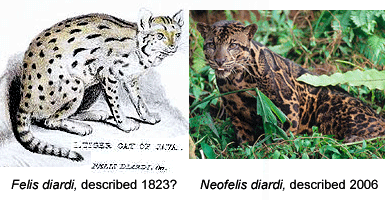
Like a telescope that reveals hidden structures in the universe, genomic analysis is a window into biodiversity. For one, differences in DNA sequences help reveal how biodiversity is partitioned into the distinct populations we call species. In Frontiers Zool 29 May 2007, researchers from University of Wurzburg, US National Cancer Institute, and Arizona State University report on mitochondrial DNA and nuclear microsatellite differences between clouded leopards (Neofelis nebulosa) from Borneo (5 individuals), Sumatra (2 individuals), and mainland SE Asia (6 individuals). This report is a follow-up on two papers in December 2006 Current Biol which proposed separate species status for Bornean clouded leopards on the basis of differences in coat pattern and DNA. Wilting et al conclude their updated results “strongly support reclassification of clouded leopards into two distinct species N. nebulosa and N. diardi“. In addition to distinct coat patterns, the two lineages differ by 4.5% in mitochondrial coding genes (cytochrome b and ATPase-8), equivalent to or larger than genetic distances between the other well-recognized species of big cats in Panthera genus (lion, jaguar, tiger, leopard, snow leopard), suggesting the two lineages of clouded leopards have been separated for about 2.86 million years.

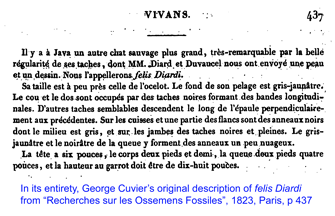
This sounds straightforward, but some taxonomists lament the increasing role of DNA in species discovery. In an editorial in current PLoS ONE, researchers from Imperial College insist the Bornean clouded leopard is not really new as it was “described by Cuvier in 1823.” Of course, by this criteria, most forms of larger animals will have been “described” by someone. Cuvier’s original work naming Felis diardi is three short paragraphs based on a single specimen and the illustration is unrecognizable.  


To my reading, Meiri and Mace’s editorial implies that most of the important taxonomic work has already been done and if new genetic data appear to upset the traditional scheme, then it is being incorrectly interpreted. They note that there are another 144 mammal species shared between Borneo and the Malay Peninsula, thus “there could potentially be equivalent evidence to merit specific status for all of these; an outcome that would surely be unjustified”.  An outcome that would surely be unjustified? This question needs to be answered by science, not by an appeal to taxonomic tradition. It may be that many island populations, which are now considered allopatric forms of widely distributed species, will turn out to be distinct species.

I close with the observation that just as genetic data can suggest splits it can also help reveal synonomies (multiple names that refer to the same species), suggest lumps, and identify forms that do NOT merit separate conservation status. For example, in Proc R Soc B 2005 Johnson et al apply mitochondrial DNA analysis to argue that the Cape Verde kite is not genetically distinct from the Black kite Milvus migrans and does not merit separate conservation status.