DNA identifies invasive parasitic wasp

Like the creatures Sigourney Weaver battles in Alien, parasitoids are organisms whose larva develop in other species, usually leading to the death of the host. Insect parasitoids are widely used as biological control agents; sometimes these efforts go awry, threatening non-pest species in local ecosystems. Widespread introduction of tachnid fly parasitoid Compsilura concinnata has failed to control Gyspy moth Lymantra dispar outbreaks in eastern US, but has led to dramatic declines in large, showy Silk moths including the beautiful Luna moth Actias luna (Elkinton and Boettler. 2004). 

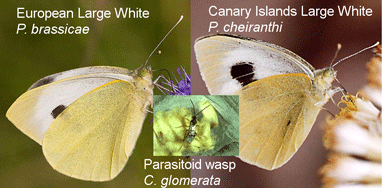
About 10% of named insect species are parasitoids, mostly wasps, but recognizing these often minute insects can be tricky. In November 2007 Conservation Genetics researchers from Czech Academy of Sciences and University of South Bohemia, Czech Republic; Natural History Museum, London; and Imperial College London apply COI DNA sequencing to identify wasps parasitizing Canary Islands Large White butterfly Pieris cheiranthi, which is restricted to local endemic ecosystem of relict laurel forests. Lozan et al reared 55 P. cheiranthi caterpillars from 2 Canary Island sites, and found half of the larva from forest margin and none from central forest were parasitized with what appeared to be Cotesia glomerata, native to Europe and introduced elsewhere as biocontrol agent although not in Canary Islands. 
3 of 600 C. glomerata-like adult wasps reared from Canary Island White larvae and 2 of 700 C. glomerata reared in Czech Republic from European Large White P. brassicae larvae were analyzed and found to have identical 5′ COI DNA sequences (this is the same region selected as a DNA barcode for animals). The authors conclude that European C. glomerata has been accidentally introduced to Canary Islands and is threatening a local endemic butterfly already under pressure from habitat loss. Without mentioning DNA barcoding by name, the authors conclude with a call for “increased effort to sequence morphological Costesia spp. from a broad geographical range…enabling the regular testing of species hypotheses…and the incorporation of all life stages using a single character set”. I hope that the authors can join forces and enable their sequences and associated metadata (eg collection location, specimen photographs, voucher information) from this and future Cotesia spp work to be usefully combined with growing COI barcode database (>415,000 COI barcode records from >41,000 species in BOLD so far, including 514 records from 89 named and provisional Cotesia spp). Looking ahead, routine application of DNA-based identification to parasitoids will help establish host ranges of potential biocontrol agents and detect inadvertent introduction of broad-range parasitoids that damage local ecosystems.

Freshwater fish DNA data debut

In June 2008 PLoS ONE, thirteen researchers from nine Canadian universities, museums, and federal agencies report on mtDNA sequences from 1360 individuals representing 195 (95%) of Canada’s 205 freshwater fish species. Hubert et al follow “best practices” established for DNA barcode records (similar criteria would enhance the value of other genetic reference data as well), namely each sequence is derived from a vouchered specimen and the barcode record includes:

  • “Bi-directional sequences of at least 500 base-pairs from the approved barcode region of COI, containing no ambiguous sites
  • Links to electropherogram trace files available in the NCBI Trace Archive
  • Sequences for the forward and reverse PCR amplification
  • Species names that refer to documented names in a taxonomic publication or other documentation of the species concept used
  • Links to voucher specimens using the approved format of institutional acronym:collection code:catalog ID number”

The researchers analyzed an average of 7.6 specimens/species, with an effort to sample across species ranges. A first pass look at genetic distances among and within Canadian freshwater fish shows results similar to those of other animal groups: average variation within species, 0.3%; average minimum distance between congeneric species (nearest neighbor), 8.3%; species with overlapping mtDNA sequences, 7% (4 species pairs and 1 flock of 5 species; one of the overlapping species pairs represents probable introgression. ) Five species showed divergent clusters differing by 1-2% in different parts of their geographic ranges, and 2 species showed larger divergences (3%, 7%); some or all of these might represent distinct species. 

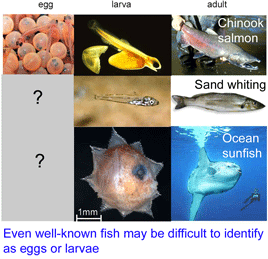
A challenge for science publishing is disseminating the large data sets that are increasingly generated. Restricting publication to only those studies with novel findings can lead to a kind of distortion, sometimes with serious consequences. The bias against negative studies, for example, is one factor contributing to the misculation of risks of medicines. As biodiversity genetics moves forward, we need ways to ensure high-quality work, receive appropriate academic credit, and disseminate results in a timely manner.  PLoS ONE describes itself as “an international, peer-reviewed, open-access, online publication…that welcomes reports on primary research from any scientific discipline.” It seems to me that this sort of forum with a focus on quality rather than novelty is needed as a home for publication of large genetic data sets including DNA barcode records. Making this information available in a timely manner will in turn help drive development of analytic and display tools and enable scientific applications, such as identification of fish eggs and larva shown above. 

First barcode data release paper is published

The first barcode data release paper has just been published by PLoS One. These data comply with the BARCODE data standard and the paper includes a table that links data records in GenBank to museum voucher specimens and data in the BOLD workbench database. This paper provides important background to our discussions with PLoS on data publication and community-based management of data curation and publication.

Hubert N, Hanner R, Holm E, Mandrak NE, Taylor E, et al. (2008) Identifying Canadian Freshwater Fishes through DNA Barcodes. PLoS ONE 3(6): e2490. doi:10.1371/journal.pone.0002490

DNA helps sort out really big animals, crowding Ark

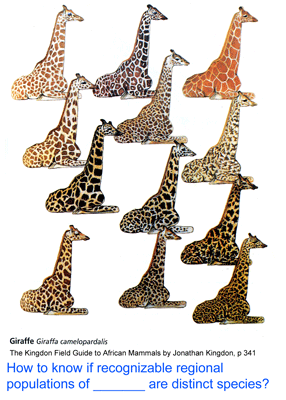
How many giraffes were onboard the Ark?  Giraffes are classified as a single species, Giraffa camelopardalis, with five to nine subspecies proposed based on regional variation in pelage (coat pattern). In 21 dec 2007 BMC Biology (open access) researchers from University of California, Los Angeles; Center for Conservation Research, Omaha Zoo; and Mpala Research Centre, Kenya, investigate genetic variation in giraffes across African continent. 
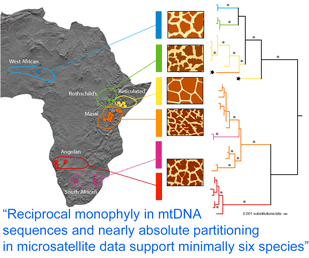
Using biopsy darts, the authors collected skin specimens from 266 giraffes at 19 localities in West, East, and South Africa. A 654 nucleotide region of mtDNA spanning cytb and control sequences was analyzed, revealing 35 haplotypes, and the remainder of the cytb gene (1709 bp total) was sequenced from one individual from each of the 35 haplotypes. The mtDNA sequences clustered into six reciprocally monophyletic lineages, which corresponded to groupings according to pelage pattern and regional location, and were largely concordant with subspecies designations.  Genetic distances suggested these groups have been reproductively isolated for 0.3 to 1.6 MY, similar to calculated divergence times among other closely-related mammals.

Analysis of 14 nuclear microsatellites from 381 individuals at 18 locations (it is not clear whether these are the same individuals as above) recovered the same six groups and suggested additional genetic subdivisions within some groups. Although at least some of the genetically and pelage-defined clusters have overlapping or adjacent ranges without geographic barriers, only three (0.8%) of individuals were identified as hybrids. These findings raise interesting questions about giraffe biology; for example, is there behavioral isolation perhaps based on visual recognition of pelage patterns? 
It is impressive that species can be overlooked in such large, boldly patterned, iconic animals.  Might there be similar divisions within the numerous species of small, brown, rarely seen mammals? Routine DNA analysis of a standardized mtDNA region (aka DNA barcoding) will help discover how finely divided animal biodiversity is.  Wilson and Reeder’s Mammal Species of the World, Third Edition lists 5,419 species, so this appears to be an achievable goal for our mammalian kin (list available online https://nmnhgoph.si.edu/msw/).  I hope the authors include barcode region COI in their next analyses, so their data can be easily combined with other data sets, including the 28,560 mammalian barcode records in BOLD to date. 

Pirelli Prize

The video for the launch of the Encyclopedia of Life earned a 15,000 euro Pirelli International Award for science communication. Thanks to Avenue A/RazorFish and all other members of the team who helped prepare it.

High school students help demonstrate practicality, utility of DNA barcoding

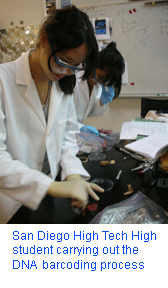
High school students in San Diego are using DNA barcoding to survey life in San Diego Bay, ranging from invasive mussels, to gastropod egg masses on eel grass, zooplankton and endangered species. Under leadership of Dr. Jay Vavra, students developed a simplified protocol for DNA extraction and amplification that can be performed in the high school’s biotechnology laboratory, and successfully identified dried jerky meat from ostrich, turkey, and beef. They have established a collaboration with East African graduate students to apply this approach to identifying bushmeat from endangered species in local African markets.

Just two years ago, in Syst Biol 55: 844, 2006 some taxonomists worried whether DNA barcoding would ever be useful: “The truth is that DNA barcoding will not have any meaningful use for the general public and even when a portable barcoder becomes available it will not lead to any increase in the biological literacy of the man in the street.” Authors Cameron et al might want to visit their local high school!

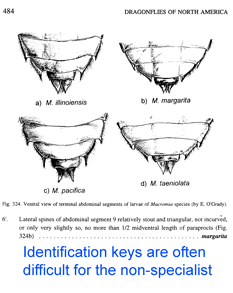
For high school students DNA barcoding seems as natural as texting. You can analyze DNA to identify species? Sure. You only need a trace sample, like a hair or a bit of dried skin? Sure, just like CSI shows. On the other side, many identification keys are not practical for most persons who would like to identify what is in their backyard.

Budget Hero

Continuing our interest in Serious Games, we encouraged the creation of an interactive video game about the US federal budget deficit through Sloan and Lounsbery.  The game, Budget Hero is off to a great start in the blogosphere (for example, freakonomics]) and more than 40,000 people have completed a play.  Congratulations to Michael Skoler, Dave Rejeski, Ben Sawyer, and other Serious Gamers.

Counting angels with DNA: update

It is impossible to describe biological diversity with traditional approaches. Molecular methods are the way forward–especially, perhaps in the form of DNA barcodes” observed Mark Blaxter in a 2003 Nature commentary, “Counting angels with DNA“, on the first paper proposing “DNA barcodes” as a standardized method for identifying species.

Five years on, how do things look? I believe the scientific and practical value of molecular (ie DNA-based) identification of species is established. Of course visual methods will often be the method of choice to identify specimens in the lab and in the field, but the standardized genetic libraries (aka DNA barcode databases) linked to specimens stored in museums are an increasingly valuable reference for assigning specimens to known species and as a means of species discovery (for more, see www.barcoding.si.edu; www.barcodinglife.org).

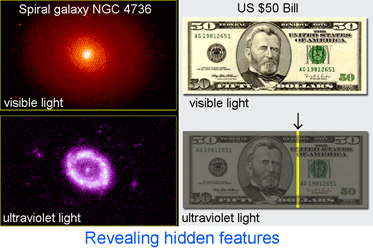
In addition to helping identify what is already known, DNA analysis can reveal what would otherwise remain hidden. In 16 May 2008 Science, researchers from Cornell College, Smithsonian Institution, US Department of Agriculture, University of Maryland, and Ithaca College use DNA to reveal hidden diversity in Blepharoneura, a neotropical genus of tephritid fruit flies that feeds within the flowers or fruits of plants in the cucumber family (Cucurbitaceae). To skip to the conclusion, mtCOI sequencing of 2857 flies reared from 24 cucurbit host species collected in six locations in Central and South America revealed 52 morphologically similar species (most were entirely indistinguishable) with “highly conserved patterns of specificity to host taxa and host parts.” Nuclear genes showed the same pattern of genetic clustering as mitochondrial COI.   
This report highlights an exciting scientific challenge raised by genetic surveys of biodiversity, including DNA barcoding: there are far more species, each with biologically specialized traits, than anyone has recognized. Condon et al report “diversity exceeding the original morphologic estimates by an order of magnitude” but conclude this must be an underestimate because of limited sampling (usually along single transects in one season at 6 sites in 5 countries), considering the vast expanse of neotropical forests in Central and South America. Also they used a conservative 4% mtCOI divergence as a cutoff (if 1% cutoff were used, an additional 10 species would be recognized, and several generalist species would be split into narrowly specialized ones).

In closing, I wish the authors had sequenced the barcode region of COI (they analyzed a 693 bp fragment from the 3′ end of the gene which does not overlap with the 5′ DNA barcode region). It would be interesting for example to compile these results with data from the tephritid fly initiative, which aims to collect DNA barcodes from the 4500 known tephritid species. Perhaps these valuable Blepharoneura DNA samples can be reanalyzed for barcode region COI.

Next up, bees

On 15 may 2008 an international assembly of bee experts gathered at York University and announced a new initiative to DNA barcode world’s bees. Some snippets from news reports:

“According to York biology professor Laurence Packer, who’s leading the group’s efforts, precisely 19,231 different kinds of bees have been identified. But he thinks there might be another 5,000 or more species out there waiting.” (Toronto Star

“There are two reasons why bee species would benefit from a barcode name tag. “Most of the specimens in museums are not identified, and the ones that are identified are only 60 to 70 percent correctly identified,” says Dr. Packer.” (University Affairs)

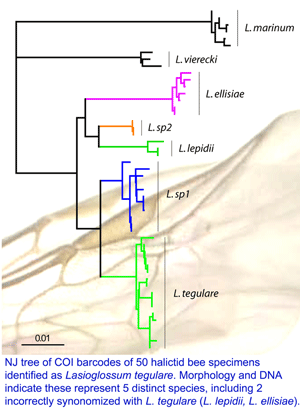
Early results, as in figure from poster at right, suggest that DNA barcoding will help sort out bee taxonomy and speed discovery of new species, with benefits to society and science.  Bees are essential pollinators for many of the world’s plants, including many endangered species, and approximately 1/3 of world’s food is derived directly or indirectly from bee-pollinated plants.

In common with other Hymenoptera (bees, wasps, ants), bees exhibit haplodiploidy (males haploid, females diploid), many species are eusocial (live in large colonies with single queens), and have greatly accelerated rates of mitochondrial evolution. Are these factors causally linked? Looking at differences among and within world’s bees may help provide fundamental insight into mitochondrial biology and evolution.  

How Did Noah’s Ark Float?

Jesse becomes engaged in the Creationism discussion, when asked
whether all life might actually voyage on Noah’s Ark, as reported
in an article Reuters’ excellent environment
correspondent, Alister Doyle.

FEATURE-How did Noah’s Ark float? New species cram aboard

Thu May 15, 2008 8:04am EDT

By Alister Doyle, Environment Correspondent

OSLO, May 15 (Reuters) – How did Noah’s Ark manage to stay afloat?

Estimates of the number of species on earth are surging into apparently hull-busting millions as biologists find new life almost everywhere they look, from African swamps to Antarctica.

The ever-widening menagerie is a paradox when an expanding human population, pollution and climate change threaten what United Nations’ studies say is the worst spate of extinctions since the dinosaurs were wiped out 65 million years ago.

Government officials trying to protect the modern world’s wildlife gather in Bonn from May 19-30 for a meeting of the U.N. Convention on Biological Diversity, to examine progress towards a goal set in 2002 of slowing biodiversity loss by 2010.

Most experts say the target is slipping out of reach.

Even so, wider research means finds of new species such as a legless lizard in Brazil or a Tanzanian shrew are testing biblical scholars’ calculations on how Noah squeezed all animals aboard the Ark.

“It’s of course physically impossible,” James Edwards, executive director of the Encyclopedia of Life, said of the biblical account.

The Encylopedia is cataloguing all identified species, 1.8 million so far, in a free online service (https://www.eol.org/).

“There are expectations of 8 to 50 million more species out there that we haven’t identified yet,” Edwards said. Other experts’ estimates of the numbers range up to 100 million.

But the newly found species do not compensate for extinctions.

Sigmar Gabriel, environment minister for the U.N. conference host Germany, said last week that the loss of species threatened food supplies for billions of people. He cited marine life, saying that if nothing was done there would be no commercial fishing by 2050.

Extinctions of recent decades include Australia’s southern gastric brooding frog — the females could shut off their stomach juices to raise young in their stomachs, a trick that could have held clues for curing human ulcers.

Believers in the Bible note that the Ark described in the Book of Genesis was a giant ship by ancient standards about 140 metres (460 ft) long — far from the tiny vessel depicted in many children’s books with giraffes’ heads sticking out the top.

In the biblical account, Noah safeguarded life on the planet after God, upset by the wickedness and violence of mankind, sent a devastating flood. “Everything on earth will perish,” God said, according to the Bible.

ALL CREATURES

Noah only took along land creatures and birds, not plants nor fish that make up a large part of the world’s total species.

“We’re talking about something plausible here,” said David Menton, an associate professor emeritus of anatomy at Washington University who works for Answers in Genesis, founder of a controversial Creation Museum in Kentucky.

The museum, which opened last year, depicts the Bible’s first book, Genesis, as literal truth. Its exhibits have been welcomed by those who believe that God created the heavens and the Earth in six days about 6,000 years ago.

Menton reckoned that Noah probably only had to take aboard about 16,000 creatures and said that most projected species discoveries are of tiny organisms.

“And we can leave out all organisms known to survive extensive flooding — such as insects and worms,” he said.

Even though creationists reject evolution, Menton said Noah may have taken along pairs to represent closely related “kinds” of animals such as dogs, wolves, coyotes and dingos, or just one pair for cows and buffaloes or tigers and lions.

He said Noah might have saved space by bringing along juveniles, including dinosaurs such as T-Rex or giant sauropods that could grow up to 30 metres (98 ft) long. Creationists believe that dinosaurs co-existed with humans.

The dimensions of the wooden Ark, given in cubits in the Book of Genesis, imply it was about 140 metres long, 23 wide and 13.5 high. It had three levels, meaning a total deck space of just short of 10,000 square metres (107,600 sq ft).

“The cargo capacity of such a ship would be impressive for those times and could be as large as 30,000 tons,” said Dragos Rauta, an expert at the International Association of Independent Tanker Owners (INTERTANKO).

Even so, the vessel would struggle to comply with modern marine transport guidelines, even with a few thousand creatures.

Noah and his family took along at least two of every type of animal and bird, and food for all on a voyage that lasted for months. The Bible also says that “clean” animals, or those deemed fit for eating such as cattle, sheep and goats, were taken in sevens.

Bjorn Clausen, managing director of Danish livestock shipping experts Corral Line AS, said large cows need at least 2 square metres each when held in pens for half a dozen animals.

“For animals like tigers, I’m not an expert but I’d say if you sail you’d need at least 4 square metres for a single tiger,” he said. What with other big animals such as kangaroos and rhinoceroses, the Ark would have quickly filled up.

HOT AND COLD

And zebras, penguins, vultures, pandas and antelope all need very different temperatures, food and habitats.

“Noah would have to be a very skilled heating and ventilation engineer … to have polar bears and iguanas on the same boat,” said Jesse Ausubel, chairman of the Encylopedia of Life at Rockefeller University in New York City.

“I’m not sure about the volume but … they wouldn’t all want the same conditions in their cabins,” he said.

The 2005 Millennium Ecosystem Assessment, a study by more than 1,300 scientists, estimated the number of identified species at 1.7-2 million with the final total likely to be between 5 and 30 million.

Of the named species, the biggest group by far, numbering around 1 million, are insects, centipedes and millipedes. Other big groups include plants, vertebrates — such as humans or whales — and molluscs. Mammals alone total more than 5,000 species — a few live in the sea, like whales.

In a line taken by creationists to argue that insects survived outside the Ark, Genesis says “everything on dry land that had the breath of life in its nostrils died” in the flood.

Insects do not have nostrils, so perhaps they survived by floating on uprooted trees or other debris.