2 December 2008 Jesse presented a seminar on the question Is Richer Greener? at the request of Rockefeller University graduate students. We post the slides from the talk, which was jointly prepared with new PHE research assistant Smriti Rao, who imaginatively updated several figures prepared as part of our work on dematerialization and the ImPACT Identity.
Blog
Growing DNA barcode database leaps past 50,000 species
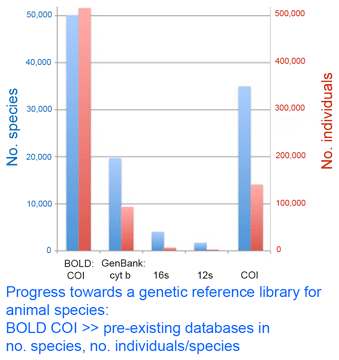 The DNA barcode initiative aims to establish a universal identification system for plant and animal species by analyzing a standardized genetic locus (or for plants, a small set of loci). In addition to making analysis cheaper, standardizing on one or a few loci enables a diverse assemblage of researchers to work together to build an interoperative library.
If there were no Human Genome Project, researchers working gene by gene might eventually have decoded the human genome sometime during this century, albeit at much slower pace using more expensive and less accurate technology. For a genetic library of biodiversity, a concerted effort is essential. The various taxon-specific genetic initiatives, which are typically aimed at reconstructing deep evolutionary history, are too limited in scope (ie number of species and individuals per species analyzed) and too expensive in terms of cost per species to completely catalog animal and plant life. In addition, because different groups analyze different gene regions, it is impossible to stitch together the results into single database, for instance one that could be used to identify an unknown specimen without knowing beforehand what group it belongs to. The DNA barcoding initiative offers the necessary framework for constructing a genetic reference database for species. In addition as a large-scale project it should help drive technological improvements analogous to those spawned by the Human Genome Project which enabled its completion for a fraction of the originally projected cost.
As of today, researchers have deposited 516,134 barcode records from 50,138 species in Barcode of Life Database (BOLD) www.barcodinglife.org. According to my analysis of GenBank shown in figure, this puts COI BOLD records far above the totals for any other single gene for animals. Thus five years of a concerted, standardized approach has leapt ahead of 30 years of incremental analysis. If the proof is in the pudding, this to me is a pudding that proves the value of the DNA barcoding initiative. Comparison of the totals indicates that most BOLD COI records are not yet in GenBank, although some aspects are visible through ID engine and Taxonomy Browser, so there is work to help move these fully into the public domain and at the same time ensure appropriate academic credit. Congratulations to all those moving this effort forward.
Everyday DNA
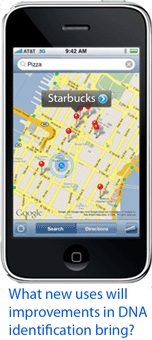 GPS devices for civilian use were first introduced 1982. The TI 4100 from Texas Instrument Company cost $150,000, weighed 50 lbs, and had heavy demand from land surveyors (GPS World, December 2004). Thanks to steady improvements in cost, size, and power demand, GPS technology is now a standard feature in cellular phones, meeting such daily needs as finding the nearest coffeeshop. The simplicity of everyday use is undergirded by an enormous investment in technology. In a 1997 report, RAND corporation estimated approximately $8 billion had been spent to develop, launch, and maintain the 24-satellite system that provides GPS signals, and the ongoing costs were $300 million/y.
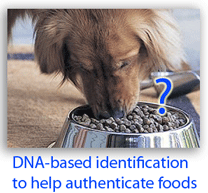 The GPS history suggests viewing the current drive to establish a DNA reference library for millions of plant and animal species as infrastructure investment, analogous to the GPS satellite system. It is relatively expensive but once established will enable diverse new applications for society and science. What uses will improvements in DNA sequencing married to a robust DNA barcode library bring?
Food authentication is likely to be one major application, including a wide array of products such as fish, olive oil, and packaged mixtures such as soups and pet food.
Making sense of Mexican microcrustaceans
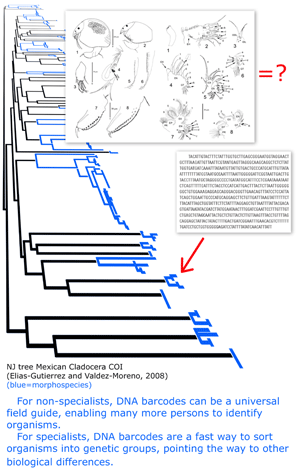 In Hidrobiologica March 2008 researchers from El Colegia de la Frontera Sur, Universidad Autonoma Metropolitana, Iztapalapa, Mexico, describe a new species of Cladocera from temporary pools in a semi-desert region. Cladocera, commonly known as “water fleas,” are minute crustaceans mostly limited to fresh water; Daphnia sp are the best known. Cladocera are of practical importance as water quality indicators.
Similar to that for other invertebrates, the species description for this minute (0.4 mm) crustacean Leberis chihuahuensis comprises about 4 pages of mysterious text and 2 pages of equally enigmatic illustrations. In addition, the DNA barcode of the type specimen is provided, as well as the more usual NJ tree, in this case showing 14% sequence divergence from its sister species L. davidi.
By including both kinds of characters, ie DNA barcode and morphology, Elias-Gutierrez and Valdez-Moreno provide what seems to me a model for any new species description, one that will enable specialists and non-specialists alike to make the most use of their findings.
.
.
CoML Highlights 2008
The Census of Marine Life releases its 4th Highlights Report, a press release about the highlights, and spectacular images. Among the highlights are the Antarctic ancestry of many octopus, the Pacific’s White Shark Café, and a historic Caribbean wall of 5 million queen conch shells. Jesse, asked about his top impressions so far, replied:
a) Technologically and politically, it is amazing and inspiring that a Census can be carried out. When the program began in 2000, such progress seemed improbable to many observers.
b) The release of the first Census in 2010 will be a scientific achievement of historic proportions, abounding in insights about what humanity knows about the oceans, what we don’t know, and what we may never know.
c) The varieties of ocean life are beautiful beyond imagination.
d) The power to see much more in the oceans brings enormous responsibilities to use the power wisely.
A Caracas newspaper includes quotes from Jesse: https://internacional.eluniversal.com/2008/11/09/ten_ava_revelan-origen-antar_09A2119843.shtml
What’s in a name?
In 2003, Paul Hebert and colleagues proposed a universal identification system employing short DNA sequences as identifiers for animal and plant species. Inspired by the Universal Product Code labels that stores use to track merchandise, he named these short sequences “DNA barcodes.” My colleagues and I set down thoughts inspired by this new name:
“Commercial barcodes and the barcode of life
Jesse Ausubel, Mark Stoeckle, Paul Waggoner
September 2004
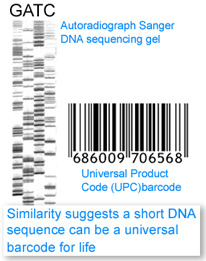 Although new methods of sequencing and visualization have displaced the one that produced autoradiographs that show blurry gray stripes of a gel indicating presence or absence of particular bits of DNA, the analogy between the commercial barcode and the barcode of life may be traced to it. However, the power of the analogy comes from other similarities: large capacities to differentiate mind-boggling diversity, ability of digits to distinguish unambiguously, rapidity and economy of identification, ability of parts of the code to distinguish categories, and avoidance of a Tower of Babel by uniformity. We elaborate briefly.
Without the final digit that checks accuracy, the quartets of bars and spaces in the Universal Product Code (UPC) have 10 alternatives at 11 locations, creating an ample 1011 capacity to identify manufacturers and their products. Instead of operating in quartets, sequences of CATG operate in trios that specify synthesis of an amino acid. Each trio of the four alternative CATG has 43 or 64 alternatives. A 600-unit sequence of DNA comprising 200 trios with 64200 alternatives opens ample capacity to identify millions of species. Such large capacities are needed to differentiate the diversity of an economy or a forest.
Because one product number in a UPC differs from another by discrete, digital steps rather than by the shades of verbal descriptions, the numbers identify the product–unambiguously. A barcode of life written as a sequence of CATG along a uniform locality of genomes differs from another by four discrete, unambiguous steps rather than by gradations of words, shapes, and colors. Barcodes gain power because digital beats analogue at making unambiguous distinctions.
Speed and economy also propel use of barcodes. Behind the beep of a UPC scanner lies orchestration that began with the initial conception of bars for numbers a half-century ago. Users and inventors orchestrated optics, electronics, and software to develop miniature, robust equipment that made the barcode an affordable master key to supermarket inventories and suppliers (Swartz 1999). Now that the price of DNA identification of a species has fallen to about $10 (Randhawa 2004), the orchestration can begin to provide a barcode of life. Uniformity fosters frequent use and thus learning and economy.
Product codes can identify products with increasing resolution. At the first level of resolution, the first bars of a UPC on a carton resolve the manufacturer. At the second level, the last bars resolve the product line. Opening the box and reading the serial number would resolve the individual. In analogous manner, extending a DNA barcode through more and more sequences would resolve from kingdoms to species, subspecies, and finally individuals. For our goal, Ockham’s razor prescribes as short a barcode of life as suffices to distinguish species.
Uniformity bestows the universality implied by the U in UPC. Scanners in hardware, grocery, and convenience stores must all call the same light bulb by the same 12 digits. Recently agreement between America and Europe added a thirteenth digit, made uniformity more widespread, and brought universality closer to realization (NY Times 12 July 2004, page C1). The power of standardization, whether in railroad gauges or typewriter keyboards, is one of the strongest lessons of the history of technology.
Finally, the success of a short DNA sequence distinguishing species will rest on reasoning, testing, and agreement, not just an appealing analogy. Reasoning will select a uniform locality on genomes that varies enough but not too much among species, testing will establish whether barcodes of that uniform locality correspond to established binomial names across several species, and then agreement will foster an expanding compilation of matching barcodes and binomial names.”
Salmon Tracking
The continental shelf tracking (“POSTâ€) project of the Census of Marine Life has tracked salmon the size of a banana 2500 km from pools in the Snake River in the Rocky Mountains, down the Columbia River, and up to Alaska . A press release occasioned by a paper in PLOS Biology earns attention, including a Reuters article that quotes Jesse, who chaired the POST Management Board during 2007-2008. Enjoy the astonishing animation of the salmon migration and photo gallery.
Harvard Magazine and EOL
Harvard magazine runs a pleasantly Harvard-centric article about the Encyclopedia of Life , crediting alumnus Jesse with raising the funds to launch EOL. Â He recalls doing a few other tasks, as well
Genetics is essential framework for microbiology, eukaryotes next?
 Robert Koch (1842-1910), father of medical microbiology, isolated agents of mankind’s major plagues: Vibrio cholera, Bacillus anthracis (anthrax and bubonic plague), and Mycobacterium tuberculosis. He laid down four conditions, “Koch’s postulates“, for establishing that an organism is the agent of disease, and subsequent generations of researchers applied these principles to determine the etiology of a multitude of infectious diseases. One legacy of Koch’s postulates was that isolation of organisms in pure culture became the backbone of diagnostic and research microbiology.
A century later, genetics has replaced culture as the essential framework for exploring microbial life. Metagenomic analysis of environmental samples, including from anatomic sites, has identified an unsuspected plethora of organisms, most of which are unculturable, at least under standard laboratory conditions. Even for organisms that can be grown in the laboratory, genetic detection is often the preferred diagnostic method, including for example detection of HIV, Neisseria gonorrhea, and Chlamydia sp. Following Carl Woese’s early lead (PNAS 1977, 74:5088), microbiologists have generally included a standard locus, 16s rRNA, in genetic work, enabling phylogenetic trees spanning the diversity of life, and allowing each new isolate to be analyzed in conjunction with the work of others (as of 24 oct 2008, 75,257 16S rRNA sequences in GenBank).
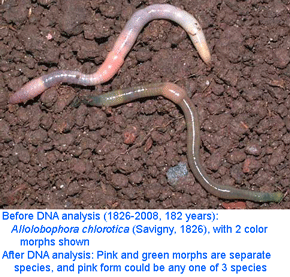
Are genetic methods equally necessary for eukaryotes? In October 2008 Mol Ecol researchers from Cardiff University analyze mitochondrial COI differences among nine species of British lumbricid earthworms which were first described between 1758 and 1843, over 150 years ago. Partial COI sequences (a 582 bp segment which overlaps 648 bp DNA barcode region) from 71 individuals showed 2-5 deeply divergent clusters (average 13-15% sequence difference) in 4 of the 8 multiply-sampled species, and small divergences within each cluster, “indicative of the presence of multiple previously undescribed species”. COI sequences from 270 individuals of one species, Allolobophora chlorotica, collected at 24 British and 5 mainland European sites showed 5 divergent clusters and surprisingly no clear geographic distribution pattern; over half the sites had 2 or more lineages, and one site had 4 lineages. As expected the same clusters were found by comparing another mitochondrial gene, 16s rRNA. Two of the lineages were found only in green color morphs; prior work indicated this form has distinct ecological preferences compared to pink morph Allo. chlorotica and that F1 hybrids are sterile, suggesting species status. As an aside, if earthworm specialists find morphological and ecological differences and mating incompatibility, why not designate as distinct species? As another example, two forms of European corn borer Ostrinia nubilalis are sympatric, genetically distinct, develop on different host plants, have different mating pheromones, and exhibit >95% reproductive isolation, yet are described as “host races” rather than separate species (Science 2005, 308:258). It sometimes seems there is an arbitrary aspect of how species status is awarded, or perhaps the process is slow.
To see if mtDNA clusters were also reflected in nuclear genome, King et al performed AFLP (amplified fragment length polymorphism) mapping on 4-12 individuals from each of the 5 lineages. The nuclear results corresponded exactly to COI clusters except that the 2 green morph forms could not be distinguished, suggesting these are either a single interbreeding species (despite 14% mtCOI sequence difference!) or are young species which have not yet accumulated differences in nuclear DNA. It is hard to see how a 14% sequence difference could accumulate in mtDNA without accompanying nuclear changes, so I wonder if one of the genetic forms might reflect a relatively recent introgression from another earthworm species which has not yet been sequenced. It will be interesting to see whether the two green morph lineages, which were often found together at the same site, show assortative mating or restricted fertility. The authors conclude “extraordinary species-level genetic diversity was revealed among the British earthworms”….”four of nine ecologically generalist earthworms are probably complexes of multiple cryptic species”. And finally “further earthworm research in areas such as ecology and ecotoxicology, should be conducted in the knowledge that there are multiple cryptic species within many earthworm species”.
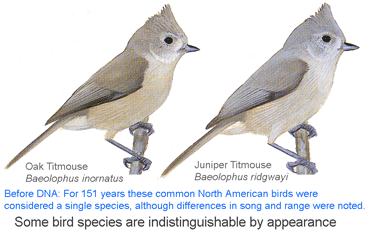 I conclude that genetics is equally essential for eukaryotic taxonomy as for microbiology. I believe there is no getting around the need to genetically reexamine most or all of the species named in the past 200 years to see if what we recognize as single and distinct species are really so. If there can be cryptic species in large visible animals such as birds, and males and females can be given different species names in fish, then there must be many more such oversights among the less easily observed. A standardized approach (ie DNA barcoding) is the most expeditious way forward and will leave a permanent marked trail that can easily be followed by non-experts who wish to identify their specimens. As in bacteria, standardizing on a single locus (ie barcode region COI for animals) enables new work to be seamlessly combined with old, leveraging its value (497,851 barcode records from 48,459 species in BOLD so far). Regarding higher-level evolutionary relationships, I find routine dismissal based on mathematical modeling of mtDNA single-locus trees, but not much effort to see what the potential is. Perhaps translated amino acid sequences and/or GC content can be informative for deeper branches, and nucleotide sequences for family- and generic-level relationships. At the very least, mtDNA trees serve to generate hypotheses, which can be corroborated or disproved by more extensive genetic, morphologic, ecologic, behavioral, or fossil record data.
Welcome Smriti Rao!
We wish a warm welcome to our newest colleague, Smriti Rao!