The French newspaper, Liberation, assembled a slide show of photos of plankton from the Bermuda triangle cruise of the Census of Marine Life by superb photographer and scientist Russell Hopcroft. (click “A voir” to view).
News
Inspired by Mars exploration, DNA sequencing gets much smaller, may be ready for field work soon
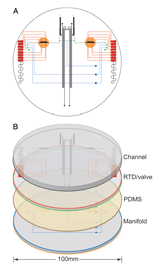 ABI’s smallest sequencer is about the size and weight of a house air conditioning unit [ABI 310: 95 kg (208 lbs); 61 x 56 x 86 cm (24 x 22 x 34 in)]. Researchers who developed the Mars Organic Analyzer for detecting extraterrestrial life recently turned their attention to DNA sequencing. In 9 May 2006 PNAS Blazej, Kumaresan, and Mathies from the University of California, Berkeley, report on a microfabricated DNA sequencer comprised of three 10 cm glass wafers. Using 1 femtomole of DNA template and a 250 nanoliter reaction chamber, the device performs thermal cycling, DNA purification, and capillary electrophoresis, generating reads of up to 556 bases with 99% accuracy. Based on their results “the template/reagent requirements can be reduced an additional 100-fold, and a fully integrated microfluidic genomic sequencing system should also lead to significant infrastructure and labor savings.”
Faster, cheaper, more portable sequencing should facilitate “point-of-use” DNA barcoding devices for identifying specimens in the field, detecting invasive species at the customs station, and sorting through museum drawers for undescribed species, for example.
How can EcoCity get its food?
A paper we encouraged Paul Waggoner to prepare, “How can EcoCity get its food?†is published. The paper examines the ecological footprint of an American diet on the land around an American city.
How many plant species are there? Facing success, some taxonomists falter
In Nature 13 april 2006 “Gardens in full bloom” by Emma Marris highlights the increasing importance of botanical gardens as centers of molecular research. One scientific goal is to compile a working list of known plant species. According to Nature, “plans for the ultimate database inevitably lead to talk of DNA barcoding. If species-specific differences in defined DNA sequences were matched with a species name in some kind of database, an untrained person could use a sequence or a DNA-chip to read the barcode in a botanical sample, send it to the database, and get back a name and all other necessary taxonomic data….Apart from its undoubted geeky appeal, such a technology would in principle save a lot of time and drudgery. Carrying out identifications for colleagues at home and round the world is time consuming and uncompensated. The use of barcoding would free up people to do their own research.”
But Peter Raven, Missouri Botanical garden, is cautious about such a scheme. He worries about how much time and effort it would take and asks “what would one do with barcodes for the 13,000 or so moss species?”
Raven’s question is like a cosmologist asking “why map the distribution of galaxies?” There is likely no way to understand the origins and patterning of biodiversity other than counting species and mapping their distributions. A rapid, simple method for identifying specimens such as DNA barcoding can make this possible. Studying a species-rich group of early terrestrial colonizers such as mosses, which live in some of the coldest and dryest environments as well as in the tropics, and provide habitats for a variety of invertebrates, might be a good place to start.
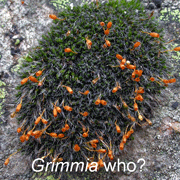 DNA analysis can also help identify new moss species. In “Cryptic species within the cosmopolitan desiccation-tolerant moss Grimmia laevigata“, Fernandez et al describe 2 cryptic species with overlapping geographic distributions. Their samples were collected only in California, so a world survey might reveal many more hidden species. The authors conclude “the results emphasize the need to make molecular characterization of species a standard part of ecological analyses of populations and communities”.
I Figli strappati
In 1982 Jesse translated from Italian into English about 200 pages from the unpublished diaries of Fey von Hassell, who had grown up in Rome in the 1930s as daughter of the German ambassador. The translation precipitated Fey’s 1987 book, “Storia Incredibile†and subsequent best-selling versions in English and German. Fey’s story is now dramatized in a 3-hour special on Italian television, “I Figli strappati.”
CoML Bermuda Triangle
The Census of Marine Life issued a press release 4 May on a cruise to look at sea bugs deep beneath the Bermuda Triangle.
Vern Ruttan Article
Jesse’s comment about Vern Ruttan’s article on technologies that might transform the economy appeared in the spring issue of the journal Issues in Science and Technology.
China Maglev Progress
While we prefer lateral suspension approach to the German approach, we are pleased to observe China speeding along the learning curve for maglev technology.
Selective sweeps limit mitochondrial diversity in animals
An exciting paper in Science 28 April 2006 “Population size does not influence mitochondrial genetic diversity in animals” by Eric Bazin, Sylvain Glemin, and Nicolas Galtier from Universite Montpellier, France, calls into question current thinking in population genetics. The authors looked at intraspecific variation in nuclear and mitochondrial DNA using sequence data collected from public databases into Polymorphix database. Contrary to expectations from population genetic theory, there was “no correlation between mtDNA polymorphism and species abundance”. Analysis of non-synonymous (amino acid changing) and synonymous (silent) changes indicated that reduced mitochondrial diversity within species reflects positive selection. They conclude “mtDNA appears to be anything but a neutral marker and probably undergoes frequent adaptive evolution… mtDNA diversity will in many instances, reflect the time since the last event of selective sweep, rather than population history and demography.” Taken together, these findings help explain the general observation of constrained intraspecific mitochondrial variation in animals, even in organisms with enormous population sizes. Recurrent selective sweeps are natural tests of species boundaries and help explain why mtDNA genealogies generally capture the biological discontinuities recognized by taxonomists as species (Avise and Walker PNAS 96:992, 1999), in short, why DNA barcoding works! It is expected that large data sets generated by DNA barcoding surveys will help refine this analysis and identify possible ecological or biological correlates, providing insight into what drives selective sweeps. I close with a question: if a species is morphologically and ecologically stable, does it nonetheless undergo repeated selective sweeps?
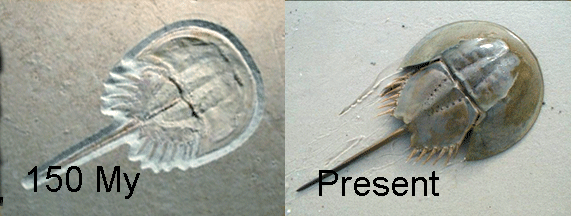
150 My of selective sweeps?
NMNH annual report headlines DNA barcoding
The lead story in the US National Museum of Natural History 2005 Annual Report: New Tools for Understanding Nature, entitled “Barcoding the Planet” highlights the  museum’s organizational and research involvement in the international scientific effort “to develop a system for rapidly and inexpensively identifying the approximately 1.7 million known flora and fauna species, and creating an electronic database for the estimated 10 million species across the planet”. As outlined by Cristian Samper, Museum Director, “the use of DNA barcoding in identifying and distinguishing species could revolutionize the way we do science”. The article concludes with an observation from Lee Weigt, Manager of the Museum’s Laboratories of Analytical Biology “What the human genome research can do for medicine, DNA barcoding can do for biology”