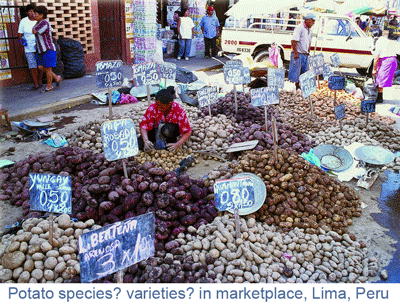
 In 7 May 2009 Amer J Botany, David Spooner, scientist at USDA and University of Wisconsin, applies DNA barcoding to wild potatoes. According to the author, “the taxonomy of sect. Petota [section Petota is a subdivision within genus Solanum which comprises wild and domesticated potatoes] is complicated by interspecific hybridization, introgression, allopolyploidy, a mixture of sexual and asexual reproduction and possible recent species divergences.” As an aside, this one genus Solanum contains over 1500 species, including such seemingly diverse plants such as nightshades, horsenettles, tomatoes, and eggplants. While the most speciose bird genera, for example, have fewer than 100 species, Solanum is one of at least 50 plant genera with over 500 species (Pelser et al 2002 Am J Botany). Such large genera are unwieldy for constructing phylogenies and testing DNA-based identification methods–do they reflect biological differences in rates of speciation among genera, or a lack of phylogenetic knowledge?
The above summary of Petota taxonomy is an understatement of the confusion regarding species boundaries in wild potatoes. For one, the apparent number of taxa seems to be shrinking rapidly: “an account of post-1990 taxonomic decisions of many workers published in Spooner and Salas (2006) reduced the 232 species of Hawkes (1990) to 190, but a taxonomic decision in my laboratory is converging on about 110 species.” Second, experts can be perplexed: “members of the complex are so similar that even experienced potato taxonomists…provided different identifications for identical collections numbers of the Solanum brevicaule complex in fully 38% of cases.” Third, genetic analysis (including multiple studies in the author’s laboratory) has been little help so far: “single- to low-copy nuclear restriction fragment length polymorphism (nRFLPs) and random amplified fragment length (RAPD) data…and amplified fragment length polymorphism (AFLP) data failed to clearly differentiate many wild species in the complex.” Independent work by researchers in the Netherlands (Jacobs et al 2008) similarly documents a challenging lack of concordance between genetics and taxonomy in Petota sp. Jacobs and colleagues performed AFLP analysis (this screens the entire nuclear genome) on 951 accessions representing 196 Petota species. Of the 196 taxa, multiple accessions of species clustered together in 58 cases, 38 formed multiple clusters, and 48 were mixed with accessions of other species. Regarding higher-level groupings, these researchers found absence of support for 4 Petota clades proposed by Spooner and colleagues, and conclude that recent speciation and high levels of hybridization will likely challenge attempts to create a genetic taxonomy of wild potatoes.
Given the above background, one might guess that a minimalist approach (ie DNA barcoding) using 2 or 3 plastid genes might not distinguish among Petota species whose underlying taxonomy and genetics are so jumbled. Thus I am puzzled why the author went to the trouble of performing this study, and why, having set out to do so, he analyzed only a single plastid gene (trnH-psbA spacer) when all recent plant barcoding studies I am aware of are based on a combined analysis of 2 or 3 plastid genes. The author also analyzed ITS nuclear gene segment (approximately 800 nucleotide segment containing ITS 1, 5.8S rRNA, and ITS2). This is interesting, although for some reason the phylogenetic analysis looked at ITS segment and trnH-psbA individually. I believe there is general understanding that a single barcode region will not suffice for distinguishing land plants. Lastly, I am puzzled why only 23 of 63 species analyzed were represented by multiple accessions. The author asserts “many barcoding studies lack robust assessments of intraspecific polymorphism or assessments of all species within a genus that are needed to assess the species-specific nature of barcodes;” as a general criticism I believe this comment is incorrect, but it does apply to the present study.
To summarize the study, 104 accessions of 63 Petota species plus 10 accessions of 9 outgroup species were analyzed (the author does not comment as to whether the selections are drawn from the revised total of 110 Petota species as defined in his laboratory). Regarding ITS, 23 species were represented by more than one accession; of these 10 species formed monophyletic lineages, which seems surprisingly good species-level resolution for a single marker in plants. With trnH-psbA, 17 species were represented by more than one accession; of these only 2 formed separate clades (1 of which did not form a distinct clade with ITS); as above, combined analysis was not done. The author dismisses matK on the basis of two previously published sequences for Petota sp. Finally, the trees used parsimony not neighbor-joining, the latter being the usual first-pass method of looking at barcode data. I find this paper a haphazard assessment of DNA barcoding in a taxonomically intensively-studied but poorly understood group.
High rates of horizontal gene transfer in archaea and eubacteria mean that it is not possible to draw clear species boundaries. It may be that relationships among potato species are similarly complex, and that species boundaries are fuzzier than the current taxonomy of morphologically-defined species would suggest. It seems to me that more taxonomic and genetic work is needed on this important group, including better tests of barcoding with combined analysis of 2 or 3 of the standard plastid regions in multiple accessions from a larger number of species. The goal of a standardized minimalist approach to identifying species, including wild potatoes, is important to help move beyond having only experts being able to identify plant species.
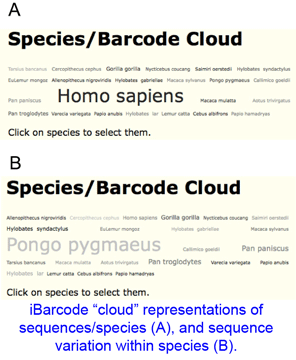 In 16 june 2009 BMC Bioinformatics researchers from University of Guelph report on web platform for DNA barcode analysis, www.iBarcode.org. The site works with aligned barcode files in standard .fas format, such as produced by MEGA or BOLD. Registration is not required; the site keeps track of files you have uploaded.
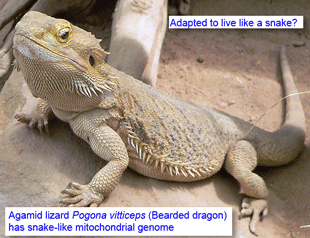 In
In  In addition to economic and environment impact, mislabeling can have public health implications. In
 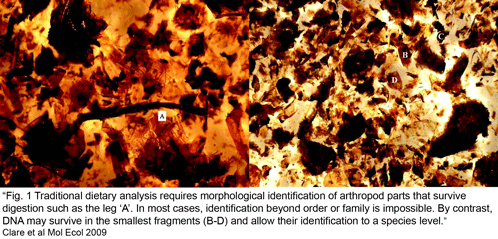 Clare et al obtained sequence data from 89% of 896 arthropod fragments; 78% of these were identified to species or genus level (the remaining 22% showed sequence similarity to bacteria, fungi, or were unidentifiable or chimeric), with a total of 127 prey species identified (125 insects, mainly lepidoptera including a number of economically important pest species, and 2 spiders). The “molecular scatology” approach documented greater diversity in prey species than prior studies based on morphologic analysis. Most prey were identified only once, with an average of 3.5 species per guano sample. Surprisingly, “more than 60% [of recovered insects] appear to have ears capable of hearing the echolocation hunting calls of L. borealis.” The authors speculate the abundance of eared moths might reflect bats hunting around streetlights, as moths in such brightly-lit environments are thought to use daytime predator-avoidance strategies rather than nocturnal responses to echolocation. There was a notable absence of actiid and tortricid moths, given their local abundance, suggesting these moths may have alternative predator-avoidance strategies.
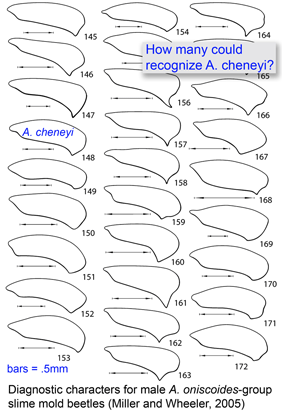 Most DNA barcoding analyses look at DNA identification through the lens of established taxonomy, ie how well does sequence data capture the species-level taxonomic categories established by morphologic analysis? In the special issue article