Citation: Challenges of a Changing Earth 175–182 2002 (Proceedings of the Global Change Open Science Conference, Amsterdam, Netherlands, 10-13 July 2001)
PDF Full Text: Maglevs and the Vision of St. Hubert
Better technology and behavior can do much to spare and restore Nature during the 21st century, even as more numerous humans prosper. Magnetically levitated trains (maglevs) symbolize technology, while the fellowship of St. Hubert with other animals symbolizes behavior. I explore the areas in human use for fishing, farming, logging, and cities. Offsetting the sprawl of cities, rising yields in farms and forests and changing tastes can spare wide expanses of land. Shifting from hunting seas to farming fish can similarly spare Nature. Cardinal resolutions to census marine life, lift crop yields, increase forest area, and tunnel for maglevs would firmly promote the Great Restoration of Nature on land and in the sea.
Keywords: maglev, St. Hubert, great restorations, farmlands, sea, forests, transportation
Areas of Research: Cities and Transportation, Technology & Human Environment
1. Introduction
The emblems of my essay are maglevs speeding through tunnels below the earth and a crucifix glowing between the antlers of a stag, the vision of St. Hubert. Propelled by magnets, maglev trains levitate passengers with green mobility. Maglevs symbolize technology, while the fellowship of St. Hubert with other animals symbolizes behavior.
Better technology and behavior can do much to spare and restore Nature during the 21st century, even as more numerous humans prosper.
In this essay I explore the areas in human use for fishing, farming, logging, and cities. Offsetting the sprawl of cities, rising yields in farms and forests and changing tastes can spare wide expanses of land. Shifting from hunting seas to farming fish can similarly spare Nature. I will conclude that cardinal resolutions to census marine life, lift crop yields, increase forest area, and tunnel for maglevs would firmly promote the Great Restoration of Nature on land and in the sea. First, let me share the vision of St. Hubert.
2. The Vision of St. Hubert
In The Hague, about the year 1650, a 25 year-old Dutch artist, Paulus Potter, painted a multi-paneled picture that graphically expresses contemporary emotions about the environment.[i] Potter named his picture “The Life of the Hunter” (Figure 1). The upper left panel establishes the message of the picture with reference to the legend of the vision of St. Hubert.[ii] Around the year 700, Hubert, a Frankish courtier, hunted deep in the Ardennes forest on Good Friday, a Christian spring holy day. A stag appeared before Hubert with a crucifix glowing between its antlers, and a heavenly voice reproached him for hunting, particularly on Good Friday. Hubert’s aim faltered, and he renounced his bow and arrow. He also renounced his riches and military honors, and became a priest in Maastricht.
The upper middle panel, in contrast, shows a hunter with two hounds. Seven panels on the sides and bottom show the hunter and his servant hounds targeting other animals: rabbit, wolf, bull, lion, wild boar, bear, and mountain goat. The hunter’s technologies include sword, bow, and guns .
One panel on either side recognizes consciousness, in fact, self-consciousness, in our fellow animals. In the middle on the right, a leopard marvels at its reflection in a mirror. On the lower left apes play with their self-images in a shiny plate.
In the large central panels Potter judges 17th century hunters. First, in the upper panel the man and his hounds come before a court of the animals they have hunted. In the lower central, final panel the animal jury celebrates uproariously, while the wolf, rabbit, and monkey cooperate to hang the hunter’s dogs as an elephant, goat, and bear roast the hunter himself. Paulus Potter believed the stag’s glowing cross converted St. Hubert to sustainability. The hunter remained unreconstructed.
With Paulus and Hubert, we can agree on the vision of a planet teeming with life, a Great Restoration of Nature. And most would agree we need ways to accommodate the billions more humans likely to arrive while simultaneously lifting humanity’s standard of living. In the end, two means exist to achieve the Great Restoration. St. Hubert exemplifies one, behavioral change. The hunter’s primitive weapons hint at the second, technology. What can we expect from each? First, some words about behavior.
3. Our Triune Brain
In a fundamental 1990 book, The Triune Brain in Evolution, neuroscientist Paul MacLean explained that humans have three brains, each developed during a stage of evolution.[iii] The earliest, found in snakes, MacLean calls the reptilian brain (Figure 2). In mammals another brain appeared, the paleomammalian, bringing such new behavior as care of the young and mutual grooming. In humans came the most recent evolutionary structure, the hugely expanded neocortex. This neomammalian brain brought language, visualization, and symbolic skills. But conservative evolution did not replace the reptilian brain, it added. Thus, we share primal behavior with other animals, including snakes. The reptilian brain controls courting mates, patrolling territory, dominating submissives, and flocking together. The reptilian brain makes most of the sensational news and will not retreat. Our brains and thus our basic instincts and behaviors have remained largely unchanged for a million years or more. They will not change on time scales considered for “sustainable development.”
Of course, innovations may occur that control individual and social behavior. Law and religion both try, though the snake brain keeps reasserting itself, on Wall Street, in the Balkans, and clawing for Nobel prizes in Stockholm.
Pharmacology also tries for behavioral control, with increasing success. Having penetrated only perhaps 10% of their global market, sales of new “anti-depressants,” mostly tinkering with serotonin in the brain, neared $10 billion in 2000. Drugs can surely make humans very happy, but without restoring Nature.
Because, I believe, behavioral sanctions will be hard-pressed to control the eight or ten billion snake brains persisting in humanity, we should use our hugely expanded neocortex on technology that allows us to tread lightly on Earth. Since ever, homo faber has been trying to make things better and to make better things. During the past two centuries we have become more systematic and aggressive about it, through the diffusion of research & development and the institutions that perform them, including corporations and universities.
What can behavior and technology do to spare and restore Nature during the 21st century? Let’s consider the seas and then the land.
4. Sparing sea life
St. Hubert exemplifies behavior to spare land’s animals. Many thousands of years ago our ancestors sharpened sticks and began hunting. They probably extinguished a few species, such as woolly mammoths, and had they kept on hunting, they might have extinguished many more. Then without waiting on St Hubert, our ancestors ten thousand years ago began sparing land animals in Nature by domesticating cows, pigs, goats, and sheep. By herding rather than hunting animals, humans began a technology to spare wild animals — on land.
In 2001 about 90 million tons of fish are being taken wild from the sea and 30 from fish farms and ranches. Sadly, little reliable information quantifies the diversity, distribution, and abundance of life in the sea, but many anecdotes suggest large, degrading changes. In any case, the ancient sparing of land animals by farming shows us an effective way to spare the fish in the sea. We need to raise the share we farm and lower the share we catch. Other human activities, such as urbanization of coastlines and tampering with the climate, disturb the seas, but today fishing matters most. Compare an ocean before and after heavy fishing.
Fish farming does not require invention. It has been around for a long time. For centuries, the Chinese have been doing very nicely raising herbivores, such as carp.
Following the Chinese example, one feeds crops grown on land by farmers to herbivorous fish in ponds. Much aquaculture of carp and tilapia in Southeast Asia and the Philippines and of catfish near the Gulf Coast of the USA takes this form. The fish grown in the ponds spare fish from the ocean. Like poultry, fish efficiently convert protein in feed to protein in meat. And because the fish do not have to stand, they convert calories in feed into meat even more efficiently than poultry. All the improvements such as breeding and disease control that have made poultry production more efficient can be and have been applied to aquaculture, improving the conversion of feed to meat and sparing wild fish.[iv] With due care for effluents and pathogens, this model can multiply many times in tonnage.
A riskier and fascinating alternative, ocean farming, would actually lift life in the oceans.[v] The oceans vary vastly in their present productivity. In parts of the ocean crystal clear water enables a person to see 50 meters down. These are deserts. In a few garden areas, where one can see only a meter or so, life abounds. Water rich in iron, phosphorus, trace metals, silica, and nitrate makes these gardens dense with plants and animals. The experiments for marine sequestration of carbon demonstrate the extraordinary leverage of iron to make the oceans bloom.
Adding the right nutrients in the right places might lift fish yields by a factor of hundreds. Challenges abound because the ocean moves and mixes, both vertically and horizontally. Nevertheless, technically and economically promising proposals exist for farming on a large scale in the open ocean with fertilization in deep water. One kg of buoyant fertilizer, mainly iron with some phosphate, could produce a few thousand tons of biomass.[vi]
Improving the fishes’ pasture of marine plants is the crucial first step to greater productivity. Zooplankton then graze on phytoplankton, and the food chain continues until the sea teems with diverse life. Fertilizing 250,000 sq km of barren tropical ocean, the size of the USA state of Colorado, in principle might produce a catch matching today’s fish market of 100 million tons. Colorado spreads less than 1/10th of 1% as wide as the world ocean.
The point is that the today’s depleting harvest of wild fishes and destruction of marine habitat to capture them need not continue. The 25% of seafood already raised by aquaculture signals the potential for Restoration (Figure 3). Following the example of farmers who spare land and wildlife by raising yields on land, we can concentrate our fishing in highly productive, closed systems on land and in a few highly productive ocean farms. Humanity can act to restore the seas, and thus also preserve traditional fishing where communities value it. With smart aquaculture, we can multiply life in the oceans while feeding humanity and restoring Nature. St. Hubert, of course, might improve the marine prospect by not eating fellow creatures from the sea.
5. Sparing farmland
What about sparing nature on land? How much must our farming, logging, and cities take?
First, can we spare land for nature while producing our food? [vii] Yields per hectare measure the productivity of land and the efficiency of land use. For centuries land cropped expanded faster than population, and cropland per person rose as people sought more proteins and calories. Fifty years ago farmers stopped plowing up nature (Figure 4). During the past half-century, ratios of crops to land for the world’s major grains-corn, rice, soybean, and wheat-have climbed fast on all six of the farm continents. Between 1972-1995 Chinese cereal yields rose 3.3% per year per hectare. Per hectare, the global Food Index of the Food and Agriculture Organization of the UN, which reflects both quantity and quality of food, has risen 2.3% annually since 1960. In the USA in 1900 the protein or calories raised on one Iowa hectare fed four people for the year. In 2000 a hectare on the Iowa farm of master grower Mr. Francis Childs could feed eighty people for the year.
Since the middle of the 20th century, such productivity gains have stabilized global cropland, and allowed reductions of cropland in many nations, including China. Meanwhile, growth in the world’s food supply has continued to outpace population, including in poor countries. A cluster of innovations including tractors, seeds, chemicals, and irrigation, joined through timely information flows and better organized markets, raised the yields to feed billions more without clearing new fields. We have decoupled food from acreage.
High-yield agriculture need not tarnish the land. Precision agriculture is the key. This approach to farming relies on technology and information to help the grower prescribe and deliver precise inputs of fertilizer, pesticides, seed, and water exactly where they are needed. We had two revolutions in agriculture in the 20th century. First, the tractors of mechanical engineers saved the oats that horses ate and multiplied the power of labor. Then chemical engineers and plant breeders made more productive plants. The present agricultural revolution comes from information engineers. What do the past and future agricultural revolutions mean for land?
To produce their present crop of wheat, Indian farmers would need to farm more than three times as much land today as they actually do, if their yields had remained at their 1966 level. Let me offer a second comparison: a USA city of 500,000 people in 2000 and a USA city of 500,000 people with the 2000 diet but the yields of 1920. Farming as Americans did 80 years ago while eating as Americans do now would require 4 times as much land for the city, about 450,000 hectares instead of 110,000.
What can we look forward to globally? The agricultural production frontier remains spacious. On the same area, the average world farmer grows only about 20 percent of the corn of the top Iowa farmer, and the average Iowa farmer lags more than 30 years behind the state-of-the-art of his most productive neighbor. On average the world corn farmer has been making the greatest annual percentage improvement. If during the next 60 to 70 years, the world farmer reaches the average yield of today’s USA corn grower, the ten billion people then likely to live on Earth will need only half of today’s cropland. This will happen if farmers maintain on average the yearly 2% worldwide growth per hectare of the Food Index achieved since 1960, in other words, if dynamics, social learning, continues as usual. Even if the rate falls to 1%, an area the size of India, globally, could revert from agriculture to woodland or other uses. Averaging an improvement of 2% per year in the productivity and efficiency of natural resource use may be a useful operational definition of sustainability.
Importantly, as Hubert would note, a vegetarian diet of 3,000 primary calories per day halves the difficulty or doubles the land spared. Hubert might also observe that eating from a salad bar is like taking a sport utility vehicle to a gasoline filling station. Living on crisp lettuce, which offers almost no protein or calories, demands many times the energy of a simple rice-and-beans vegan diet.[viii] Hubert would wonder at the greenhouses of the Benelux countries glowing year round day and night. I will trust more in the technical advance of farmers than in behavioral change by eaters. The snake brain is usually a gourmet and a gourmand.
Fortunately, lifting yields while minimizing environmental fall out, farmers can effect the Great Restoration.
6. Sparing forests
Farmers may no longer pose much threat to nature. What about lumberjacks? As with food, the area of land needed for wood is a multiple of yield and diet, or the intensity of use of wood products in the economy, as well as population and income. Let’s focus on industrial wood — logs cut for lumber, plywood, and pulp for paper.
The wood “diet” required to nourish an economy is determined by the tastes and actions of consumers and by the efficiency with which millers transform virgin wood into useful products.[ix] Changing tastes and technological advances are already lightening pressure on forests. Concrete, steel, and plastics have replaced much of the wood once used in railroad ties, house walls, and flooring. Demand for lumber has become sluggish, and in the last decade world consumption of boards and plywood actually declined. Even the appetite for pulpwood, logs that end as sheets of paper and board, has leveled.
Meanwhile, more efficient lumber and paper milling is already carving more value from the trees we cut.[x] And recycling has helped close leaks in the paper cycle. In 1970, consumers recycled less than one-fifth of their paper; today, the world average is double that.
The wood products industry has learned to increase its revenue while moderating its consumption of trees. Demand for industrial wood, now about 1.5 billion cubic meters per year, has risen only 1% annually since 1960 while the world economy has multiplied at nearly four times that rate. If millers improve their efficiency, manufacturers deliver higher value through the better engineering of wood products, and consumers recycle and replace more, in 2050 virgin demand could be only about 2 billion cubic meters and thus permit reduction in the area of forests cut for lumber and paper.
The permit, as with agriculture, comes from lifting yield. The cubic meters of wood grown per hectare of forest each year provide strong leverage for change. Historically, forestry has been a classic primary industry, as Hubert doubtless saw in the shrinking Ardennes. Like fishers and hunters, foresters have exhausted local resources and then moved on, returning only if trees regenerated on their own. Most of the world’s forests still deliver wood this way, with an average annual yield of perhaps two cubic meters of wood per hectare. If yield remains at that rate, by 2050 lumberjacks will regularly saw nearly half the world’s forests (Figure 5). That is a dismal vision — a chainsaw every other hectare, skinhead Earth.
Lifting yields, however, will spare more forests. Raising average yields 2 percent per year would lift growth over 5 cubic meters per hectare by 2050 and shrink production forests to just about 12 percent of all woodlands. Once again, high yields can afford a Great Restoration.
At likely planting rates, at least one billion cubic meters of wood — half the world’s supply — could come from plantations by the year 2050. Semi-natural forests — for example, those that regenerate naturally but are thinned for higher yield — could supply most of the rest. Small-scale traditional “community forestry” could also deliver a small fraction of industrial wood. Such arrangements, in which forest dwellers, often indigenous peoples, earn revenue from commercial timber, can provide essential protection to woodlands and their inhabitants.
More than a fifth of the world’s virgin wood is already produced from forests with yields above 7 m3 per hectare. Plantations in Brazil, Chile, and New Zealand can sustain yearly growth of more than 20 m3 meters per hectare with pine trees. In Brazil eucalyptus — a hardwood good for some papers — delivers more than 40 m3 per hectare. In the Pacific Northwest and British Columbia, with plentiful rainfall, hybrid poplars deliver 50 m3 per hectare.
Environmentalists worry that industrial plantations will deplete nutrients and water in the soil and produce a vulnerable monoculture of trees where a rich diversity of species should prevail. Meanwhile, advocates for indigenous peoples, who have witnessed the harm caused by crude industrial logging of natural forests, warn that plantations will dislocate forest dwellers and upset local economies. Pressure from these groups helps explain why the best practices in plantation forestry now stress the protection of environmental quality and human rights. As with most innovations, achieving the promise of high-yield forestry will require feedback from a watchful public.
The main benefit of the new approach to forests will reside in the natural habitat spared by more efficient forestry. An industry that draws from planted forests rather than cutting from the wild will disturb only one-fifth or less of the area for the same volume of wood. Instead of logging half the world’s forests, humanity can leave almost 90 % of them minimally disturbed. And nearly all new tree plantations are established on abandoned croplands, which are already abundant and accessible. Although the technology of forestry rather than the behavior of hunters spared the forests and stags, Hubert would still be pleased.
7. Sparing pavement
What then are the areas of land that may be built upon? One of the most basic human instincts, from the snake brain, is territorial. Territorial animals strive for territory. Maximizing range means maximizing access to resources. Most of human history is a bloody testimony to the instinct to maximize range. For humans, a large accessible territory means greater liberty in choosing the points of gravity of our lives: the home and the workplace.
Around 1800, new machines began transporting people faster and faster, gobbling up the kilometers and revolutionizing territorial organization.[xi] The highly successful machines are few—train, motor vehicle, and plane—and their diffusion slow. Each has taken from 50 to 100 years to saturate its niche. Each machine progressively stretches the distance traveled daily beyond the 5 km of mobility on foot. Collectively, their outcome is a steady increase in mobility. For example, in France, from 1800 to today, mobility has extended an average of more than 3% per year, doubling about every 25 years. Mobility is constrained by two invariant budgets, one for money and one for time. Humans always spend an average 12-15% of their income for travel. And the snake brain makes us visit our territory for about one hour each day, the travel time budget. Hubert doubtless averaged about one hour of walking per day.
The essence is that the transport system and the number of people basically determine covered land.[xii] Greater wealth enables people to buy higher speed, and when transit quickens, cities spread. Both average wealth and numbers will grow, so cities will take more land.
The USA is a country with a fast growing population, and expects about another 100 million people over the next century. Californians pave or build on about 600 m2 each. At the California rate, the USA increase would consume 6 million hectares, about the combined land area of the Netherlands and Belgium. Globally, if everyone new builds at the present California rate, 4 billion added to today’s 6 billion people would cover about 240 million hectares, midway in size between Mexico and Argentina.
Towering higher, urbanites could spare even more land for nature. In fact, migration from the country to the city formed the long prologue to the Great Restoration. Still, cities will take from nature.
But, to compensate, we can move much of our transit underground, so we need not further tar the landscape. The magnetically levitated train, or maglev, a container without wings, without motors, without combustibles aboard, suspended and propelled by magnetic fields generated in a sort of guard rail, nears readiness (Figure 6). A route from the airport of Shanghai to the city center will soon open. If one puts the maglev underground in a low pressure or vacuum tube, as the Swiss think of doing with their Swissmetro, then we would have the equivalent of a plane that flies at high altitude with few limitations on speed. The Swiss maglev plan links all Swiss cities in 10 minutes.[xiii]
Maglevs in low pressure tubes can be ten times as energy efficient as present transport systems. In fact, they need consume almost no net energy. Had Hubert crossed the USA in 1850 to San Francisco from St. Louis on the Overland Stage, he would have exhausted 2700 fresh horses.
Future human settlements could grow around a maglev station with an area of about 1 km2 and 100,000 inhabitants, be largely pedestrian, and via the maglev form part of a network of city services within walking distance. The quarters could be surrounded by green land. In fact, cities please people, especially those that have grown naturally without suffering the sadism of architects and urban planners.
Technology already holds green mobility in store for us. Naturally maglevs want 100 years to diffuse, like the train, auto, or plane. With maglevs, together with personal vehicles and airplanes operating on hydrogen, Hubert could range hundreds of kilometers daily for his ministry, fulfilling the urges of his reptilian brain, while leaving the land and air pristine.
8. Cardinal Resolutions
How can the Great Restoration of Nature I envision be accomplished? Hubert became only a Bishop, but in his honor, I propose we promote four cardinal resolutions, one each for fish, farms, forests, and transport.
Resolution one: The stakeholders in the oceans, including the scientific community, shall conduct a worldwide Census of Marine Life between now and the year 2010. Some of us already are trying.[xiv] The purpose of the Census is to assess and explain the diversity, distribution, and abundance of marine life. This Census can mark the start of the Great Restoration for marine life, helping us move from uncertain anecdotes to reliable quantities. The Census of Marine Life can provide the impetus and foundation for a vast expansion of marine protected areas and wiser management of life in the sea.
Resolution two: The many partners in the farming enterprise shall continue to lift yields per hectare by 2% per year throughout the 21st century. Science and technology can double and redouble yields and thus spare hundreds of millions of hectares for Nature. We should also be mindful that our diets, that is, behavior, can affect land needed for farming by a factor of two.
Resolution three: Foresters, millers, and consumers shall work together to increase global forest area by 10%, about 300 million hectares, by 2050. Furthermore, we will concentrate logging on about 10% of forest land. Behavior can moderate demand for wood products, and foresters can make trees that speedily meet that demand, minimizing the forest we disturb. Curiously, neither the diplomacy nor science about carbon and greenhouse warming has yet offered a visionary global target or timetable for land use.[xv]
Resolution four: The major cities of the world shall start digging tunnels for maglevs. While cities will sprawl, our transport need not pave paradise or pollute the air. Although our snake brains and the instinct to travel will still determine travel behavior, maglevs can zoom underground, sparing green landscape.
Clearly, to realize our vision we shall need both maglevs and the vision of St. Hubert. Simply promoting the gentle values of St. Hubert is not enough. Soon after he painted his masterpiece, Paulus Potter died of tuberculosis and was buried in Amsterdam on 7 January 1654 at the age of 29. In fact, Potter suffered poor engineering. Observe in The Life of the Hunter that the branch of the tree from which the dogs hang does not bend.
Because we are already more than 6 billion and heading for 10 in the new century, we already have a Faustian bargain with technology. Having come this far with technology, we have no road back. If Indian wheat farmers allow yields to fall to the level of 1960, to sustain the present harvest they would need to clear nearly 50 million hectares, about the area of Madhya Pradesh or Spain.
So, we must engage the elements of human society that impel us toward fish farms, landless agriculture, productive timber, and green mobility. And we must not be fooled into thinking that the talk of politicians and diplomats will achieve our goals. The maglev engineers and farmers and foresters are the authentic movers, aided by science. Still, a helpful step is to lock the vision of the Great Restoration in our minds and make our cardinal resolutions for fish, farms, forests, and transport. In the 21st century, we have both the glowing vision of St. Hubert and the technology exemplified by maglevs to realize the Great Restoration of Nature.
Acknowledgements: Georgia Healey, Cesare Marchetti, Perrin Meyer, David Victor, Iddo Wernick, Paul Waggoner, and especially Diana Wolff-Albers for introducing me to Paulus Potter.
Figures
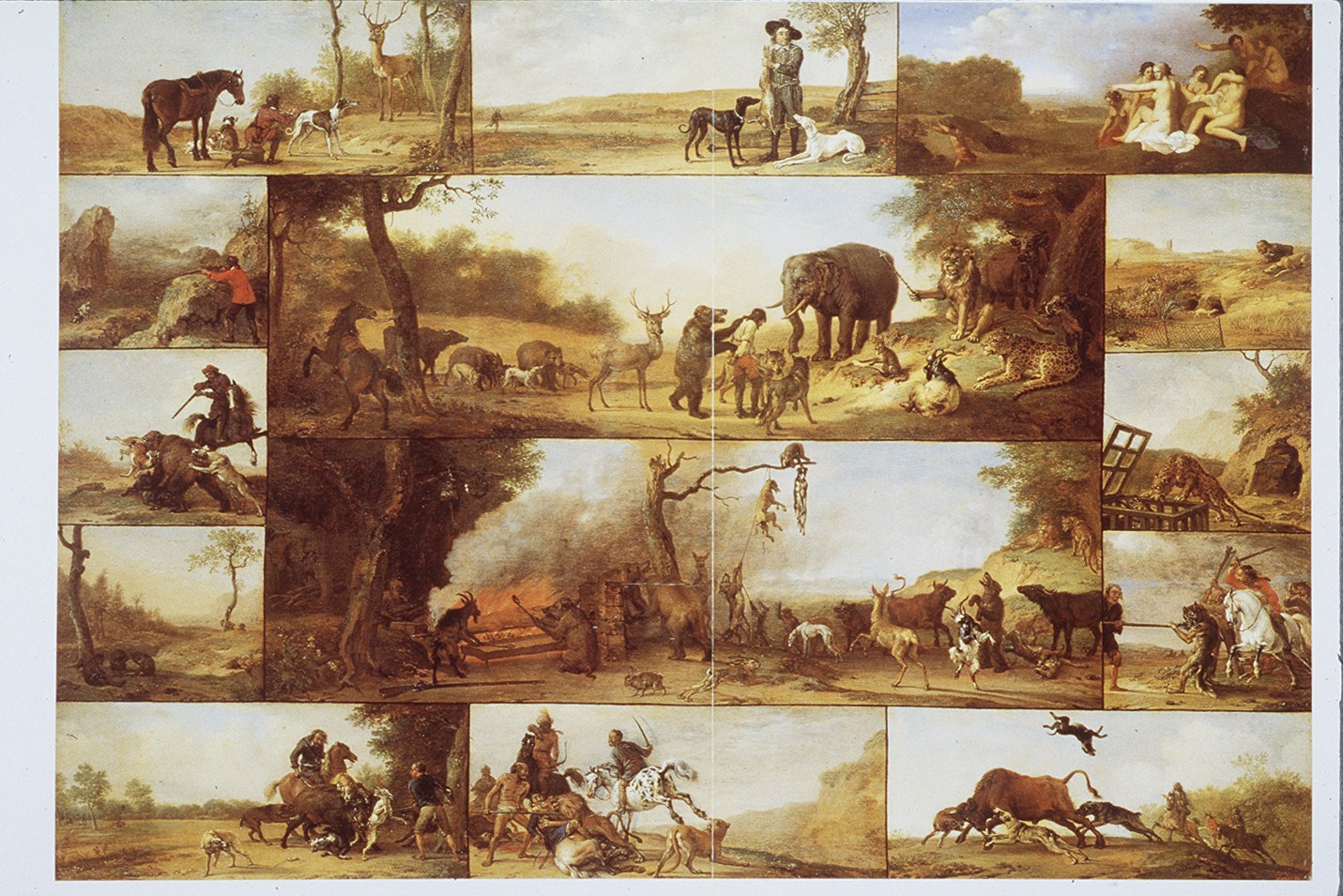
Figure 1. The Life of the Hunter by Paulus Potter. The painting hangs in the museum of the Hermitage, St. Petersburg.
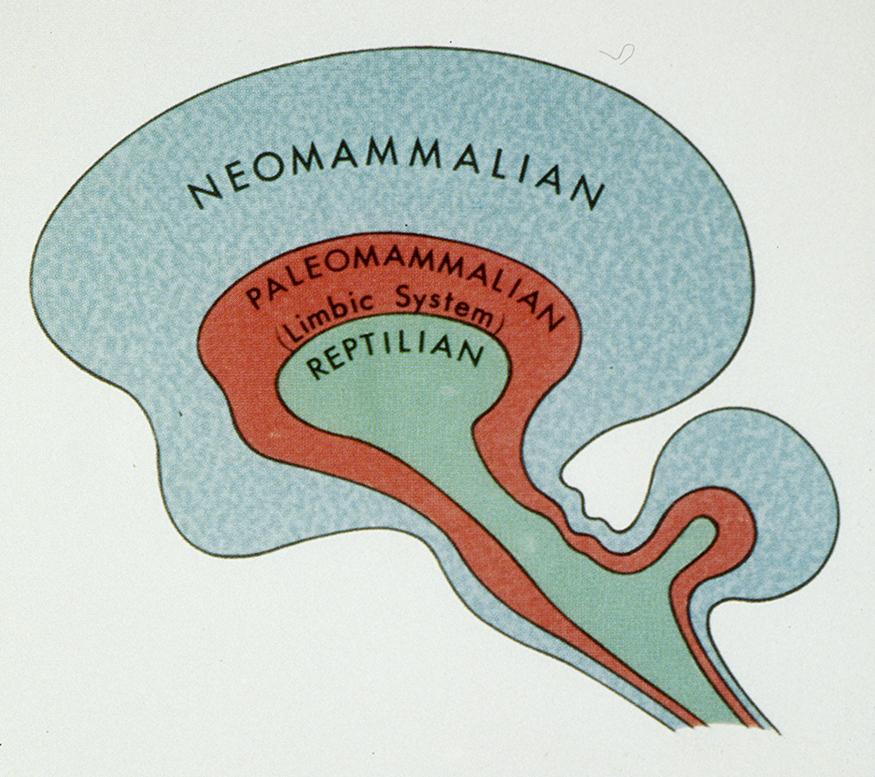
Figure 2. Symbolic representation of the triune brain. Source: P. D. MacLean, 1990.
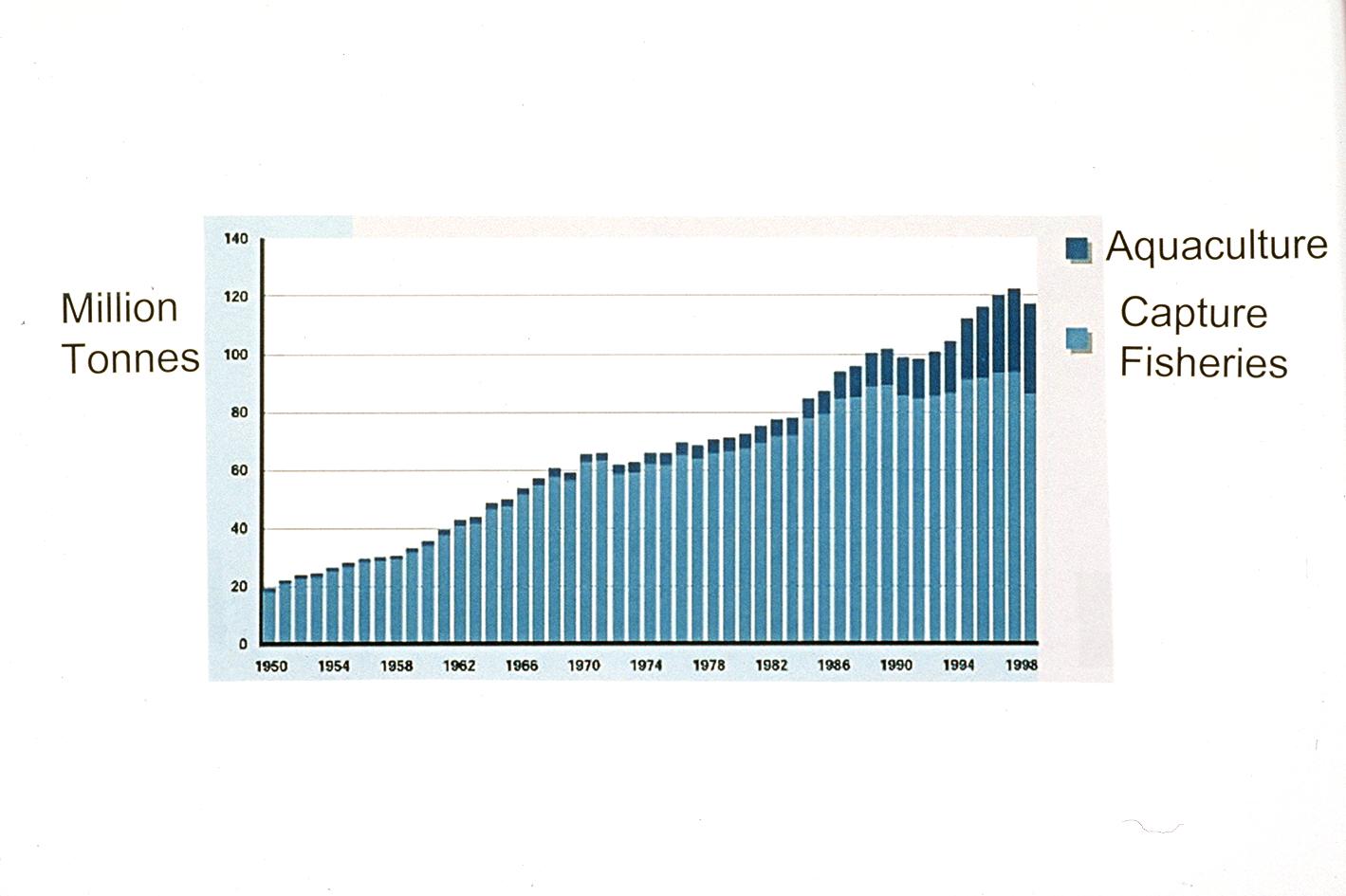
Figure 3. World capture fisheries and aquaculture production. Note the rising amount and share of aquaculture. Source: Food and Agriculture Organization of the UN, The state of world fisheries and aquaculture 2000, Rome. https://www.fao.org/DOCREP/003/X8002E/X8002E00.htm
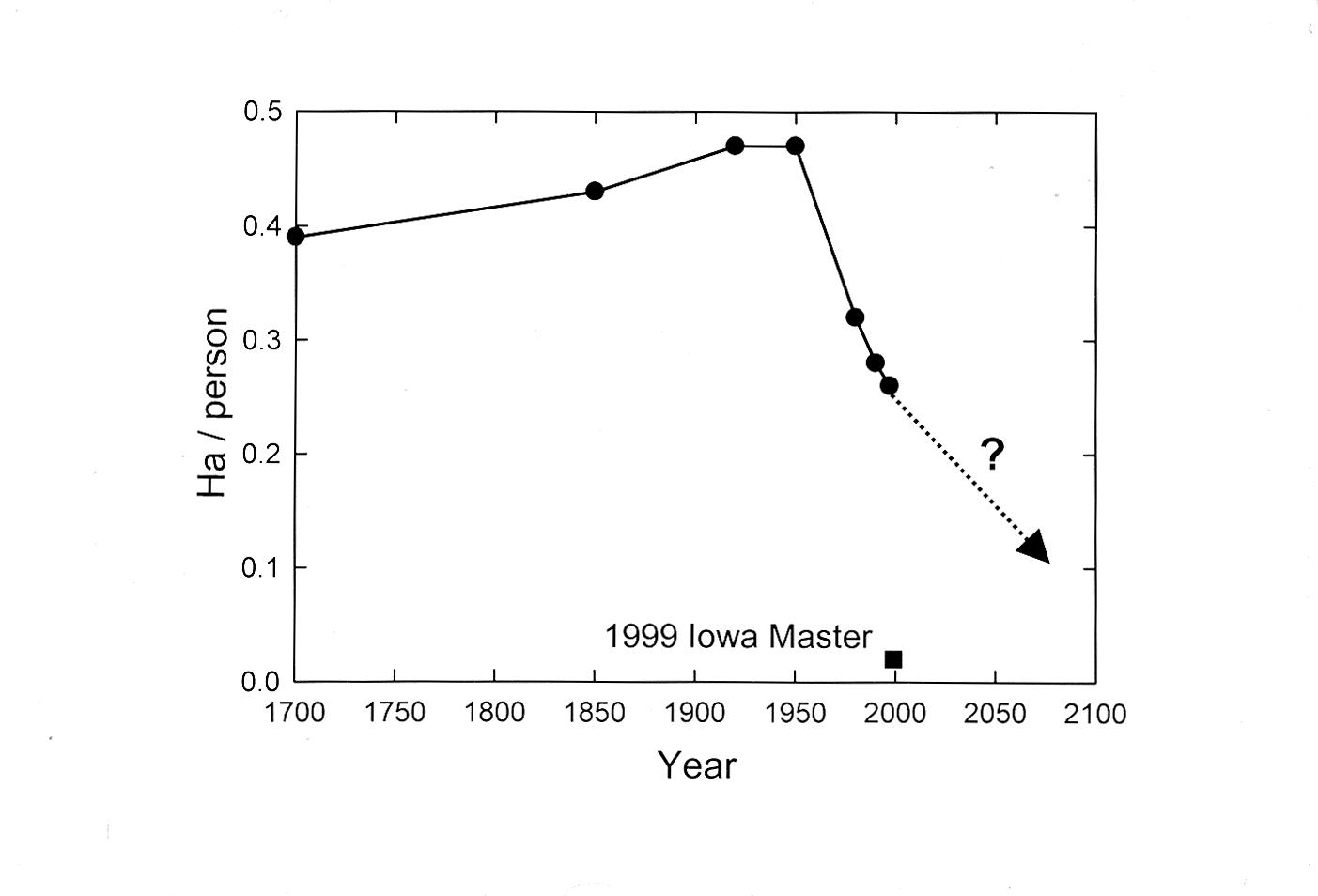
Figure 4. Reversal in area of land used to feed a person. After gradually increasing for centuries, the worldwide area of cropland per person began dropping steeply in about 1950, when yields per hectare began to climb. The square shows the area needed by the Iowa Master Corn Grower of 1999 to supply one person a year’s worth of calories. The dotted line shows how sustaining the lifting of average yields 2 percent per year extends the reversal. Sources of data: Food and Agriculture Organization of the United Nations, various Yearbooks. National Corn Growers Association, National Corngrowers Association Announces 1999 Corn Yield Contest Winners, Hot Off the Cob, St. Louis MO, 15 December 1999; J. F. Richards, 1990, “Land Transformations,” in The Earth as Transformed by Human Action, B. L. Turner II et al. eds., Cambridge University: Cambridge, UK.
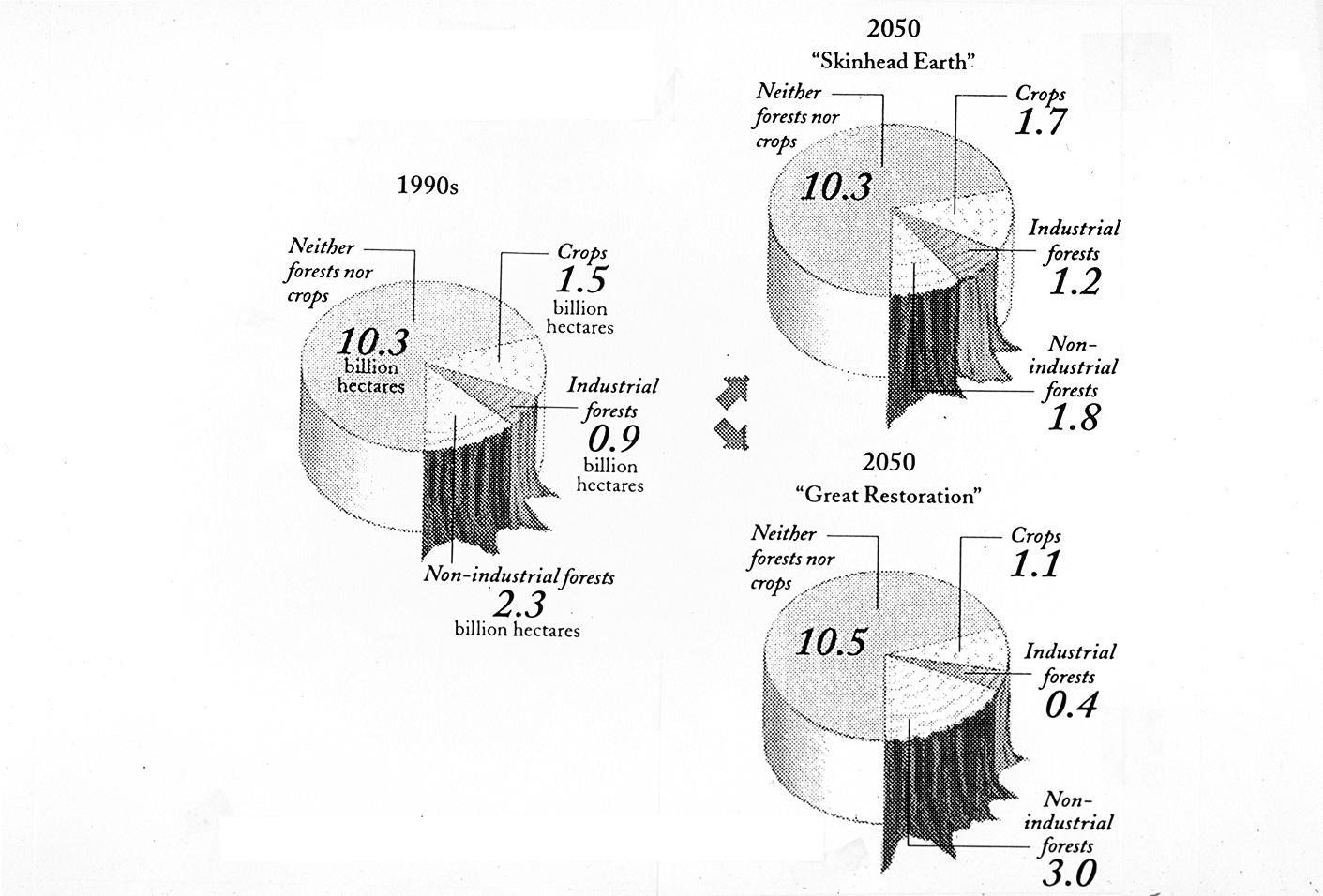
Figure 5. Present and projected land use and land cover. Today’s 2.4 billion hectares used for crops and industrial forests spread on “Skinhead Earth” to 2.9 while in the “Great Restoration” they contract to 1.5. Source: D. G. Victor and J. H. Ausubel, Restoring the Forests, Foreign Affairs 79(6): 127-144, 2000.
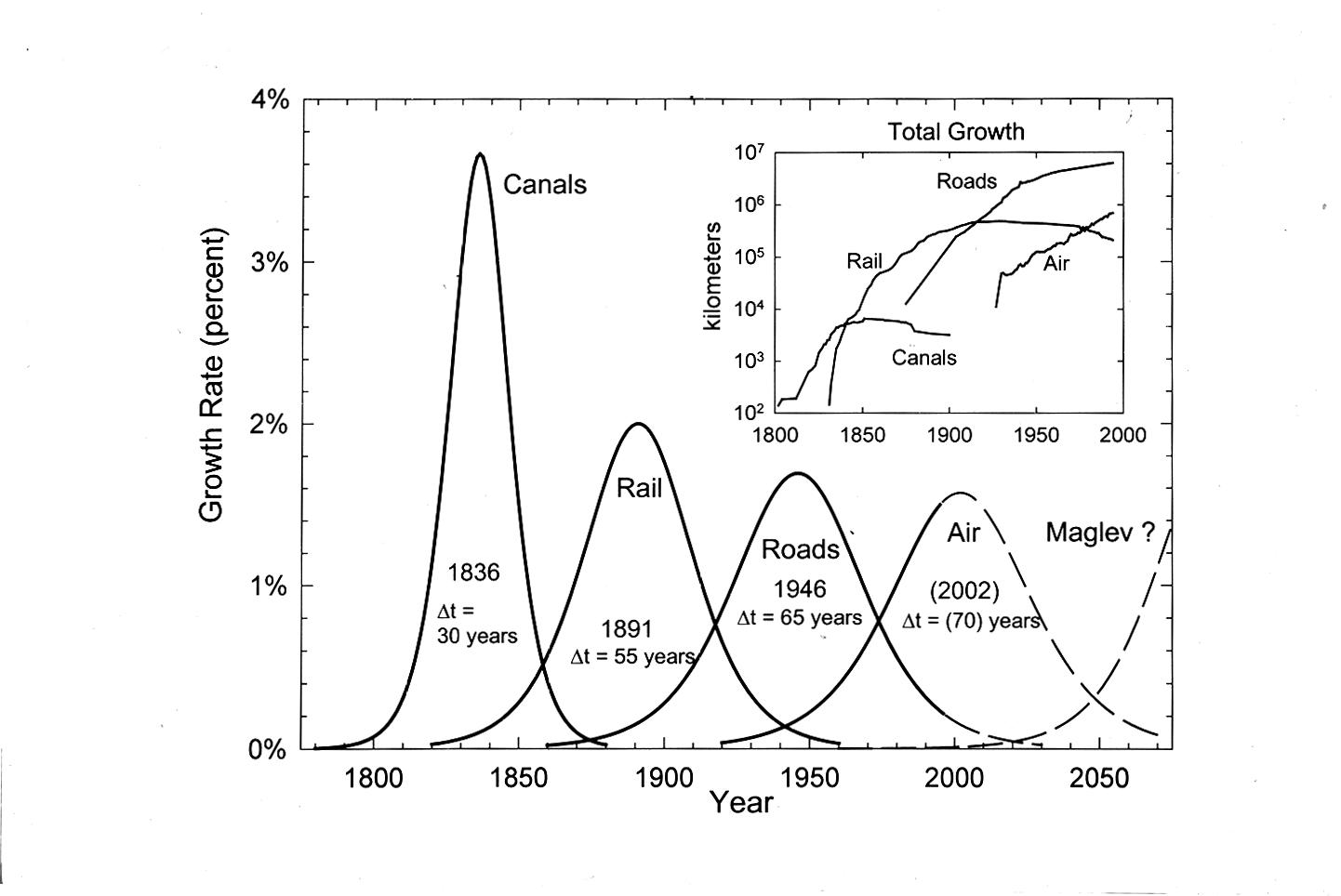
Figure 6. Smoothed historic rates of growth (solid lines) of the major components of the US transport infrastructure and conjectures (dashed lines) based on constant dynamics. Rhythm evokes a new entrant now, maglevs. The inset shows the actual growth, which eventually became negative for canals and rail as routes were closed. Delta t is the time for the system to grow from 10% to 90% of its extent. Source: Toward Green Mobility: The Evolution of Transport, J. H. Ausubel, C. Marchetti, and P. S. Meyer, European Review 6(2): 137-156 (1998).
References and Notes
[i] A. Walsh, E. Buijsen, and B. Broos, Paulus Potter: Schilderijen, tekeningen en etsen, Waanders, Zwolle, 1994.
[ii] The upper right panel shows Diana and Acteon, from the Metamorphosis of the Roman poet Ovid. Acteon, a hunter, was walking in the forest one day after a successful hunt and intruded in a sacred grove where Diana, the virgin goddess, bathed in a pond. Suddenly, in view of Diana, Acteon became inflamed with love for her. He was changed into a deer, from the hunter to what he hunted. As such, he was killed by his own dogs. This panel was painted by a colleague of Potter.
[iii] P. D. MacLean, The Triune Brain in Evolution: Role in Paleocerebral Functions, Plenum, New York, 1990.
[iv] In some fish ranching, notably most of today’s ranching of salmon, the salmon effectively graze the oceans, as the razorback hogs of a primitive farmer would graze the oak woods. Such aquaculture consists of catching wild “junk” fish or their oil to feed to our herds, such as salmon in pens. We change the form of the fish, adding economic value, but do not address the fundamental question of the tons of stocks. A shift from this ocean ranching and grazing to true farming of parts of the ocean can spare others from the present, on-going depletion.
[v] J. H. Ausubel, The Great Reversal: Nature’s Chance to Restore Land and Sea, Technology in Society 22(3):289-302, 2000; M. Markels, Jr., Method of improving production of seafood. US Patent 5,433,173, July 18, 1995, Washington DC.
[vi] Along with its iron supplement, such an ocean farm would annually require about 4 million tons of nitrogen fertilizer, 1/20th of the synthetic fertilizers used by all land farms.
[vii] P. E. Waggoner and J. H. Ausubel, How Much Will Feeding More and Wealthier People Encroach on Nature? Population and Development Review 27(2):239-257, 200.
[viii] G. Leach, Energy and Food Production, IPC Science and Technology Press, Guildford UK, 1976, quantifies the energy costs of a range of food systems.
[ix] I. K. Wernick, P. E. Waggoner, and J. H. Ausubel, Searching for Leverage to Conserve Forests: The Industrial Ecology of Wood Products in the U.S., Journal of Industrial Ecology 1(3):125-145, 1997.
[x] In the United States, for example, leftovers from lumber mills account for more than a third of the wood chips turned into pulp and paper; what is still left after that is burned for power.
[xi] J. H. Ausubel, C. Marchetti, and P. S. Meyer, Toward Green Mobility: The Evolution of Transport, European Review 6(2):143-162, 1998.
[xii] P. E. Waggoner, J. H. Ausubel, I. K. Wernick, Lightening the Tread of Population on the Land: American Examples, Population and Development Review 22(3):531-545, 1996.
[xiii] www.swissmetro.com
[xiv] J. H. Ausubel, The Census of Marine Life: Progress and Prospects, Fisheries 26 (7): 33-36, 2001.
[xv] D. G. Victor and J. H. Ausubel, Restoring the Forests, Foreign Affairs 79(6): 127-144, 2000.