The Intergovernmental Panel on Climate Change has recently retreated from its fantastical “8.5” scenarios, as reported in a recent column by Michael Shellenberger on the capture of the IPCC by those with an alarmist bias that cites Jesse Ausubel. The 8.5 scenario originated in the year 2000. But the Business-As-Usual scenario in the first IPCC report in 1990 was equally extreme. As a reviewer of the first IPCC report, Jesse critiqued the BAU scenario as “Brezhnevite” but his review was totally ignored.
Below are a few paragraphs that repeat Jesse’s 1990 critique of the IPCC BAU scenario from Jesse’s 1994 paper Technical Progress and Climatic Change published in Energy Policy 23 (4/5): 411–416 1995 (also pp. 501-512 in “Integrated Assessment of Mitigation, Impacts, and Adaptation to Climate Change,” N Nakicenovic, WD Nordhaus, R Richels, and FL Toth (eds), International Institute for Applied Systems Analysis, Laxenburg, Austria, 1994).
Excerpt: This possibility is illustrated by the final technological trajectory discussed here, that of decarbonization, or the decreasing carbon intensity of primary energy, measured in tons of carbon created per kilowatt year of electricity (or its equivalent) (Figure 8). As is evident, the global energy system has been steadily economizing on carbon. Without gloomy climate forecasts or dirty taxes.
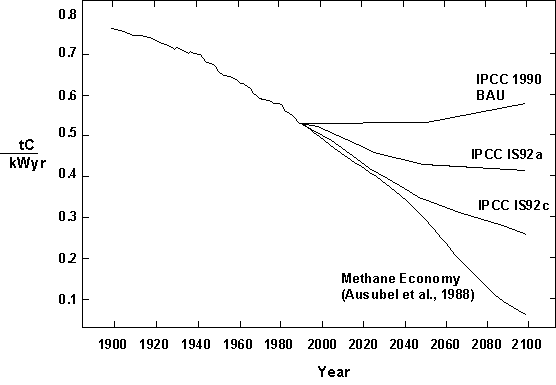
Figure 8. Carbon intensity of primary energy, 1900-1990, with projections to 2100. The projection stopping the historic trend of decarbonization is the IPCC 1990 “Business as Usual” (BAU) scenario; IPCC IS92a and ISP2c are high and low energy scenarios from the 1992 Supplement. Sources: Intergovernmental Panel on Climate Change (IPCC), 1990, 1992; Ausubel et al., 1988.
In a peculiar choice of words, the Intergovernmental Panel on Climate Change in 1990 designated as “Business-as-Usual” its scenario which stifled and even reversed the 130-year trend. “Business as Usual” was a scenario of technical regression. It essentially ignored the scientific and technical achievement of the past 300 years, including the achievements that make identification and estimation of the greenhouse effect possible. [End of excerpt.]
It’s good to see the lunatic BAU and 8.5 scenarios put in their proper place, if only after 35 years and a lot of harm. All this was in the open literature. Science is not always scientific.